Cloud Phone Systems: Never miss a call and boost customer satisfaction
Have you ever wondered how much time your team spends managing calls, messages, and client contacts...


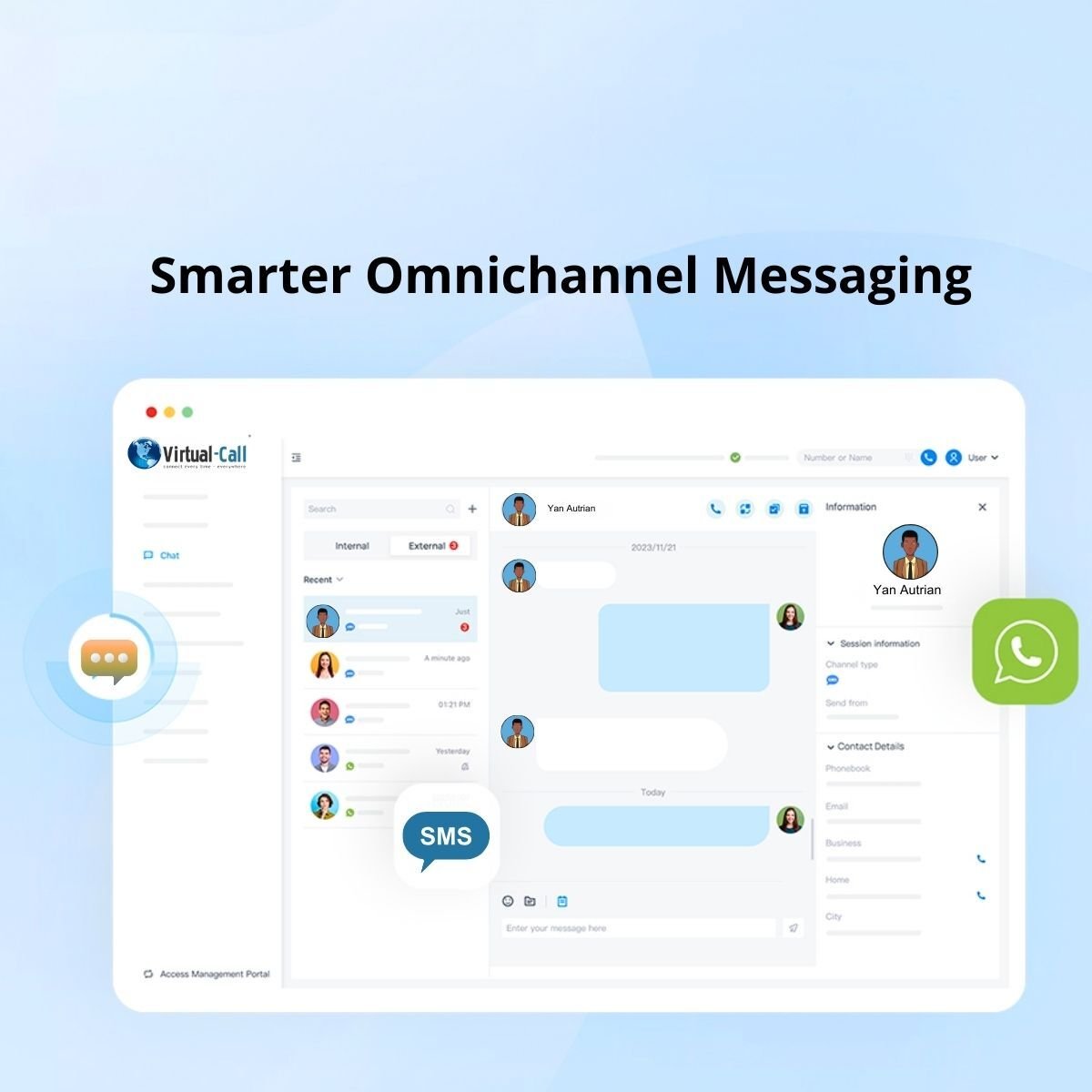
Your customer opened a ticket on WhatsApp. The next day, they sent an email. This morning, they called and had to explain everything from scratch. Again.
That experience has a cost. Not just in lost time, but in satisfaction, loyalty, and ultimately, revenue.
Industry research shows that 73% of customers use multiple channels in a single support journey, and 68% expect context to be shared across channels automatically. Yet most businesses still operate with fragmented tools, overloaded teams, and customers who repeat themselves every time they switch channels.
Omnichannel communication solves this at the root: WhatsApp, SMS, live chat, and social media connected in a single platform, with unified history and context preserved across every interaction.
In this article, you'll learn how it works in practice, what measurable results it delivers, and what separates businesses already benefiting from those still losing customers to fragmented communication.
Omnichannel communication means delivering a seamless, consistent experience to customers regardless of which channel they choose to contact you.
Unlike a multichannel approach, where each channel operates independently, omnichannel connects all interactions in one platform. Your team sees the complete customer history, even if someone started a conversation on WhatsApp and continued it the next day on live chat.
In practice, that means a customer can:
Open a conversation on your website's live chat
Follow up on WhatsApp the next morning
Receive an update by SMS
And your team will have the full context in a single view; repetition is required.
This isn't a passing trend. It's a competitive requirement backed by consistent data.
Industry benchmarks show that 73% of customers use multiple channels during a single support journey. That means the majority of your clients are already moving between phone, chat, SMS, and social media before resolving an issue, and they expect your business to follow that movement without friction.
The problem is that most businesses still can't. According to sector research, 68% of customers expect context to be shared across channels without having to repeat themselves at every new interaction. When that continuity breaks down, the experience deteriorates, and the customer notices.
The satisfaction impact is measurable. Customers who use live chat combined with at least one other channel report 23% higher satisfaction than those served through a single channel. Integration, by itself, already generates results.
The long-term effect compounds. According to the Aberdeen Group study "Omni-Channel Customer Care: Empowered Customers Demand a Seamless Experience", companies with strong omnichannel engagement strategies retain 89% of their customers and grow at 9.5% year-over-year, compared to 33% retention and 3.4% growth for the rest.
According to Deloitte Digital, customers who receive high-quality omnichannel experiences are 3.6 times more likely to make additional purchases.
The numbers are clear: omnichannel communication is no longer optional; it is the standard your customers already expect. Businesses that integrate channels, context, and history into a single experience gain more satisfaction, retention, and recurring revenue. Those that don't continue losing both time and opportunities to fragmentation.
WhatsApp has become the dominant business messaging channel across Europe (including DACH), Latin America, and Asia, with over 3 billion monthly active users worldwide.
For B2B companies with international operations, this is where your clients and partners already are, making WhatsApp integration not a feature but a baseline expectation for cross-border communication.
According to Meta and market reports, businesses exchange billions of messages daily via WhatsApp Business (with 200M+ MAUs), generating approximately US$45 billion in global sales annually. For companies in the DACH region and beyond, an enterprise-level WhatsApp platform is no longer optional.
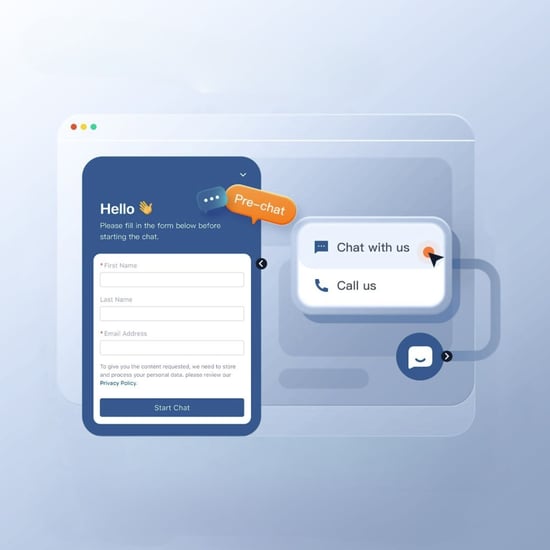
Live Chat: Call or chat directly in your website in just one click.
Live chat provides immediate support for visitors who are still researching, comparing options, or ready to make a decision. Industry benchmarks consistently place live chat among the highest-performing service channels, with satisfaction rates of 85–87%, outperforming both email and social media.
And when a text conversation isn't enough, agents can escalate to a voice call in a single click without asking the customer to call a different number or wait for a callback. More on that feature below.
Despite the growth of messaging apps, SMS remains the most reliable channel for time-sensitive communications: delivery confirmations, appointment reminders, and critical alerts. Industry benchmark data shows 78% customer satisfaction for SMS-based support, with an average first-response time of just 8 minutes, outperforming email in urgent scenarios.
With open rates consistently exceeding 90%, the message is clear: when it matters that your customer reads what you sent, SMS delivers.
Facebook Messenger and other social platforms have evolved from marketing tools to legitimate customer service touchpoints. However, social media still records an average satisfaction rate of 71%, below live chat and phone, primarily due to slow response times and a lack of shared context between interactions.
That figure points to both the problem and the solution. When Messenger is integrated into the same environment as chat, WhatsApp, and phone with centralized history and automatic assignment, performance improves consistently. The channel is not the issue; fragmentation is.
The real operational shift happens when you centralize everything. A unified inbox pulls all messages from WhatsApp, live chat, SMS, Facebook, and other channels into a single interface.
No more lost context. Every interaction is logged in the same place. Your team does not start from scratch every time a returning customer makes contact, and the 68% who expect exactly that will find what they need.
Fluid assignment and transfer. Conversations can be assigned to specific agents or moved between departments without losing history. If a sales conversation requires technical follow-up, the handoff is seamless and invisible to the customer.
Automatic contact matching. The system identifies the customer by phone number or email and associates the message with their complete interaction history; no manual lookup required.
Smart conversation routing. Incoming messages are automatically directed to available agents or specialized teams, distributing workload evenly and reducing both response delays and agent overload.
For Virtual-Call, this centralized environment carries an additional dimension: trilingual support in English, German, and Portuguese, integrated in the same platform. For companies operating simultaneously in the Brazilian market and the DACH region, that is not a minor detail; it is a core operational requirement.
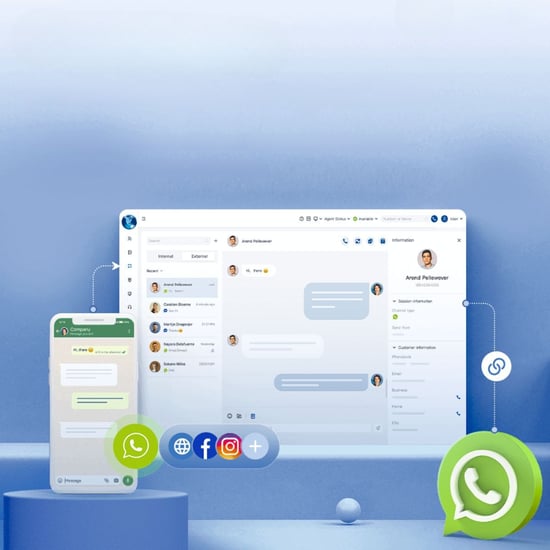
WhatsApp Integration: Messsage to queue, chat assignment and transfer, central chat records, and more.
Beyond inbound support, the platform supports proactive communication at scale. Teams can send bulk SMS campaigns or WhatsApp messages using pre-approved templates, with real-time tracking of each campaign's delivery status completed, executing, retrying, and detailed reporting per contact.
This transforms the Cloud PBX from a reactive service tool into a proactive communication engine. Discover more about the latest Cloud PBX features that help teams work faster and smarter.
For companies with existing CRM, BI, or analytics infrastructure, the omnichannel message API allows inbound messages to be routed directly to third-party analytics platforms. Every WhatsApp, SMS, or chat conversation becomes structured data feeding your existing reporting tools without manual export or integration workarounds.
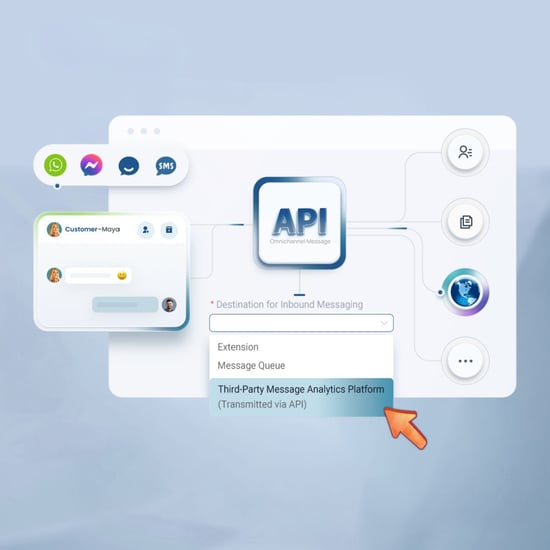
Route messages to analytics platforms via Omnichannel Message API
Not every issue resolves via text. Consumer behavior data shows that channel preference shifts with problem complexity: for complex issues, 44% of customers prefer phone, and 31% prefer live chat; for purchase decisions, 41% prefer live chat, and 35% prefer phone.
This validates the “start in chat, escalate to voice” model: customers begin in text for quick questions but expect to move to a call when the difficulty requires more depth, without losing context and without calling a separate number.
One-click chat-to-call escalation solves exactly that scenario. The agent retains the full history. The customer repeats nothing.
When all agents are busy, messages remain organized in a visible queue. Customers receive an automatic acknowledgment, ensuring no request goes unnoticed or unanswered.
The experience your customers have across channels directly affects their satisfaction, loyalty, and likelihood of future purchases.
What benchmark data shows by channel:
Live chat: 85–87% satisfaction, consistently the highest-performing channel
Phone: follows closely, with satisfaction rates near live chat levels
SMS: approximately 78% satisfaction
Social media: around 71%, especially when operating in isolation without a shared context
The common thread: when channels work separately, perception drops. Integration is what levels the experience upward consistently.
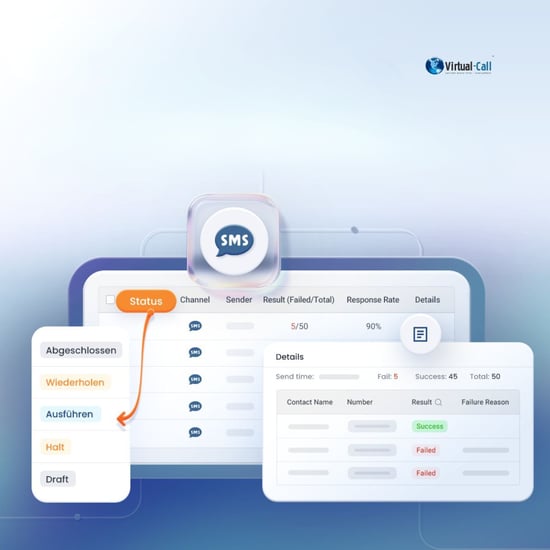
Outbound Bulk Messaging via SMS Channel
Why centralization matters for support and sales teams:
For the team, having everything in one place means less time switching between systems, no need to ask clients for information they have already provided, faster responses through templates and automations, and smarter workload distribution through intelligent queuing.
The result: faster service for the customer, more efficient operations for the team.
The customer communication landscape is evolving rapidly.
According to Infobip's 2026 Trends Report (November 2025), AI-powered agents are projected to manage up to 95% of customer engagements, moving well beyond basic FAQ bots to handle complex, context-aware conversations across text and voice.
The future of customer service isn't automation versus humans; it's both, combined. AI handles volume and routine requests; human agents handle nuance, complexity, and the moments that define the relationship.
Platforms like WhatsApp and RCS are converging on super app models that integrate messaging, marketing, and payments in a single interface, driving exponential growth in brand-to-customer conversation volumes.
For businesses without a unified platform, that volume increase will create operational strain. For those who are prepared, it's a growth opportunity.
Omnichannel communication is particularly valuable for:
Companies managing high inbound communication volumes
Businesses operating across multiple countries or languages
Distributed sales and support teams
Organizations expanding into new markets
Enterprises looking to reduce service costs without compromising quality
You now have the full picture: customers moving between channels, teams slowed down by fragmentation, and a real competitive window for businesses that act before their rivals do.
Omnichannel communication is not a future promise; it is the standard your customers already expect. Connecting channels, centralizing history, and eliminating the friction of “Could you repeat that?” is what separates reactive operations from businesses that grow with consistency.
The title promised you would learn how to unify your channels and retain more customers. The strategy is here. The next step is putting it into practice.
Virtual-Call's omnichannel messaging solution is available in the Cloud PBX Enterprise and Ultimate plans. It integrates live chat, SMS, WhatsApp, and Facebook into a central inbox with automatic contact matching, smart conversation routing, queue management, and one-click chat-to-call escalation.
Built on Oracle Cloud infrastructure and backed by trilingual support in English, German, and Portuguese, it's designed for companies that operate across borders and can't afford communication gaps.
Ready to see it in action? Schedule a consultation and discover how Virtual-Call simplifies omnichannel communication for international businesses.
Connecting you to the world! 🌏
Source: Aberdeen Group Publishes Contact Center and Customer Experience Management Research