Wholesale voice termination: how it works and what to assess
Wholesale voice termination enables carriers, VoIP operators, and service providers to route voice...



Comparing wholesale voice costs requires more than placing two per-minute rates side by side.
Destination, network, traffic profile, CLI requirements, traffic volume, billing structure, and commercial terms can all affect the effective cost of a route and determine whether an offer actually fits the operation.
For carriers, VoIP operators, and resellers, the more useful question is not simply, “Which provider has the lowest rate?”
It is: What will this route actually cost for my traffic profile, and under which conditions does that rate apply?
A route may look competitive on a rate sheet but become less suitable once caller identification, traffic characteristics, capacity, or billing conditions are taken into account.
This guide shows you what to check in a rate deck, how billing increments, CLI, and call origin can affect the comparison, and which traffic data to bring to a negotiation.
You’ll also find a side-by-side comparison framework and a pre-agreement checklist to help you qualify, test, and negotiate a route that fits your operation.
Updated on 11/19/2026
The per-minute rate is an important reference point, but it does not represent the full cost of a voice route.
Consider two hypothetical offers. One has a lower headline rate but does not meet the CLI requirements of the traffic.
The other has a slightly higher rate but supports the required caller identification and matches the expected traffic profile.
Comparing price alone would make the first offer appear more attractive. Operationally, however, the comparison is incomplete.
This is why the first question should not be: Which route is cheaper?
It should be: Are these two offers actually equivalent for the traffic I need to send?
Only after establishing that can the headline rates be compared meaningfully.
For a broader overview of how calls move between carriers and reach the destination network, read our guide to how wholesale voice termination works.
A rate deck is the table that sets out the rates and conditions applicable to voice termination traffic. When comparing offers, three areas deserve particular attention.
Do not look only at the country. Rates may vary according to:
This matters because traffic is rarely distributed evenly across every destination in a rate deck.
An offer that appears less expensive overall may produce a higher effective cost if most of your traffic is concentrated on networks or prefixes with higher rates.
Before comparing two providers, identify where your volume actually goes.
Check the currency in which rates are quoted and the currency in which the traffic will be billed. This becomes particularly relevant when wholesale voice costs and customer revenue are denominated in different currencies.
A small exchange-rate movement may appear insignificant on an individual call. When applied to large traffic volumes over an entire billing period, however, the financial impact can become more material.
Currency should therefore be treated as part of the commercial comparison rather than an administrative detail.
Two routes may carry the same headline per-minute rate and still generate different effective costs. The reason is that providers may apply different minimum billable periods and billing increments to call duration.
This difference becomes particularly relevant for traffic containing a large proportion of short calls. Small differences in the way individual calls are billed can accumulate across a high-volume operation.
For that reason, compare the per-minute rate and the billing conditions together.
The lowest headline rate does not automatically mean the lowest effective cost for your traffic.
A wholesale rate makes more sense when it is evaluated against an actual traffic profile. Before requesting or negotiating a route, prepare information such as:
A high-volume operation dominated by short calls is not necessarily equivalent to conventional conversational traffic.
Capacity matters as well. A route expected to handle thousands of simultaneous sessions presents a different requirement from an operation using a limited number of channels.
Traffic volume can influence commercial negotiations, but forecast volume and delivered traffic should not be treated as the same thing.
An estimate helps a provider evaluate the expected demand and prepare an initial commercial proposal. Once the service is in production, actual traffic can provide a stronger basis for reviewing the conditions.
A useful sequence is:
forecast volume → testing → delivered volume → commercial review
This creates a more realistic basis for negotiation than relying exclusively on projections.
CLI is not only a technical consideration. Depending on the route, destination, and call origin, caller identification can affect both eligibility and commercial conditions.
Before comparing offers, clarify:
Some routes use Origin-Based Charging, or OBC.
Under this model, the termination rate can vary according to the origin of the call. That means two calls to the same destination may not necessarily be priced under the same conditions if their origins differ.
CLI and origin, therefore, need to be considered when reading the rate deck, rather than being checked only after the commercial comparison has already been made.
Comparing two wholesale voice offers only makes sense when the commercial, traffic, and technical conditions are placed side by side.
A lower headline rate may look attractive at first. But if the two routes differ in billing model, CLI requirements, accepted traffic profile, or capacity, the comparison is no longer like-for-like.
Use the matrix below to identify where the offers are genuinely equivalent and where further clarification is needed before making a decision.
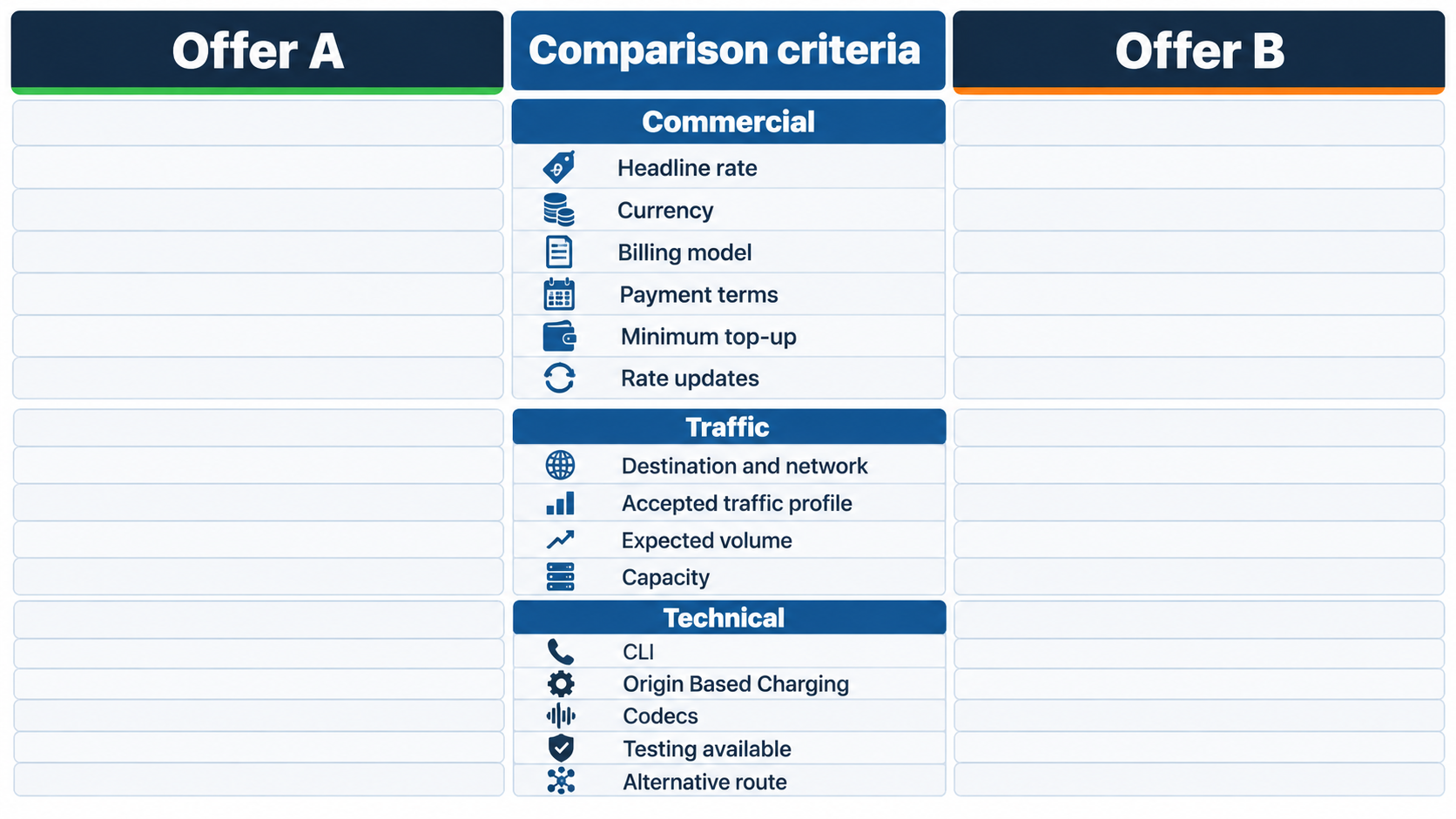
The aim is not to find the offer with the lowest value in a single row. It is to understand which route best matches the actual traffic under commercially sustainable conditions.
Reaching an agreement on the rate should not be the end of a wholesale route evaluation. Where possible, test the route with traffic that represents the intended production environment before committing significant volume.
A test may cover:
The results should help answer two separate questions:
Does the route technically fit the traffic?
and
Do the commercial conditions make the route viable at production volume?
A route can pass the first test and fail the second.
A productive wholesale negotiation starts before asking for a discount.
Instead of asking:
“What is your best rate?”
Provide the information required to understand the scenario:
“We need a route for these destinations, with this expected traffic volume, this traffic profile, this concurrency, and these CLI requirements.”
A more precise traffic profile gives both sides a better basis for determining whether the proposed route and commercial conditions are relevant.
It is not always necessary to negotiate every destination in an A-Z rate deck. If a significant share of your traffic is concentrated on a limited number of destinations or networks, those rates deserve more attention.
A reduction in a destination carrying very little traffic may have almost no effect on the overall economics of the operation.
A small difference on a destination receiving substantial volume may matter considerably more. Start with your traffic distribution, then prioritise the negotiation.
First, establish whether the route fits the traffic. Then test it. Only after the technical and operational fit is better understood should volume and commercial conditions become the main negotiation.
A disciplined sequence looks like this:
qualify → test → analyse → negotiate → scale
This reduces the risk of negotiating an excellent rate for a route that cannot support the intended traffic.
A lower rate is not automatically a lower effective cost. Check whether the traffic, CLI, and billing conditions are actually equivalent.
Volume, duration, concurrency, and call behaviour can all affect route suitability. A proposal based on an inaccurate traffic profile may become unsuitable once production traffic begins.
Do not assume that routes designed for different traffic patterns are interchangeable. Separating traffic profiles before comparing offers creates a more realistic commercial and technical assessment.
Identical per-minute rates can produce different total costs when billing models differ.
Caller identification and call origin may affect which rate applies. Ignoring those conditions can result in a different cost from the one expected from the headline rate.
Wholesale termination rates can change. The operation should have a process for receiving, reviewing, and applying new rate decks before they take effect.
Controlled testing makes it easier to identify technical or commercial incompatibilities before they affect a large proportion of production traffic.
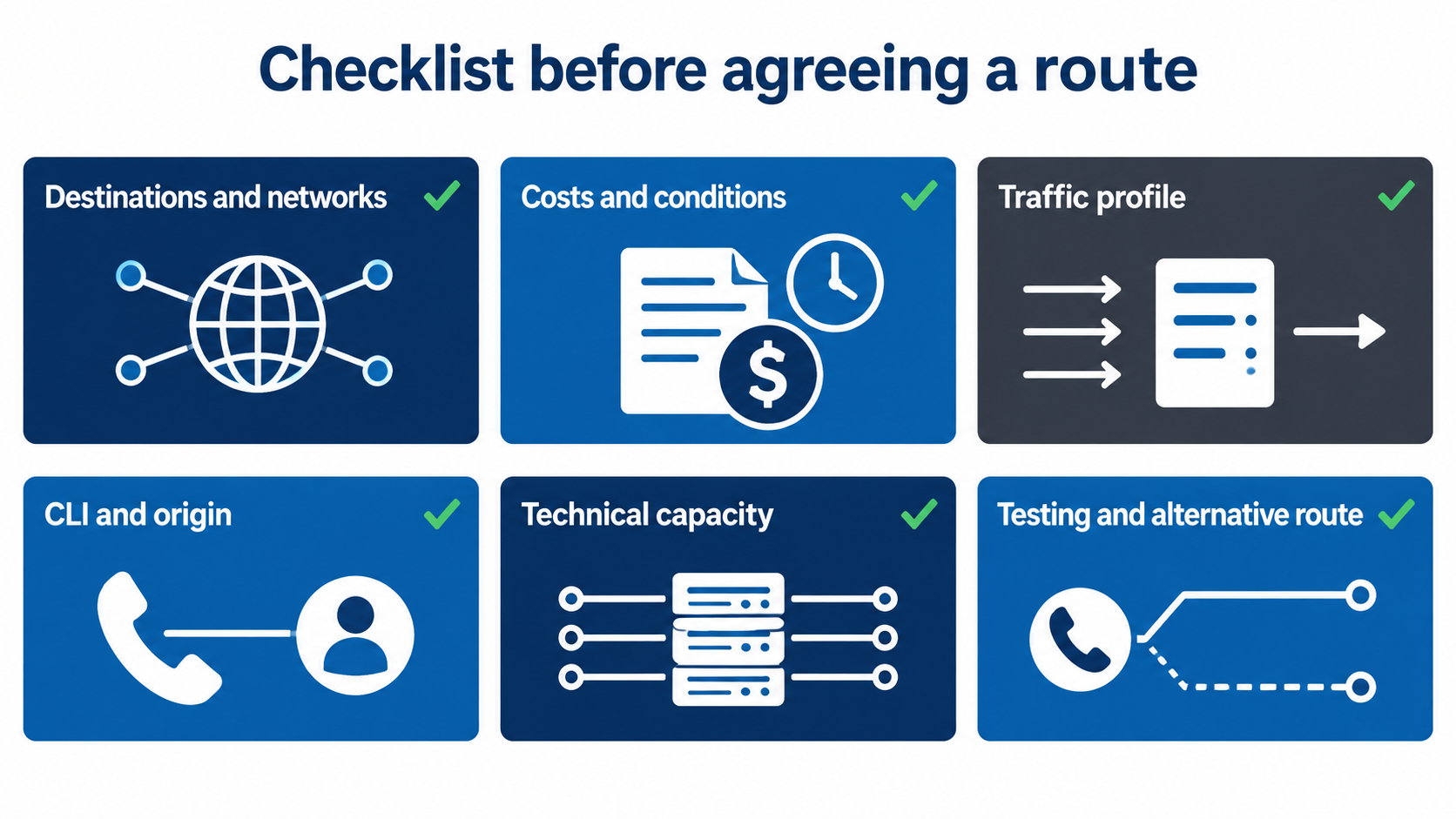
The six areas above provide a practical starting point, but each one includes more detailed commercial and technical conditions.
Before approving a route, confirm the applicable rates, billing model, capacity, CLI requirements, codecs, numbering format, payment terms, testing conditions, support, and alternative routing options.
If any condition remains unclear, clarify it with the provider before committing significant production traffic.
A route evaluation starts with the traffic profile. When contacting Virtual-Call, prepare information such as:
This gives the team a clearer basis for evaluating which of Virtual-Call’s wholesale VoIP termination options may match your traffic profile and under which conditions.
Need to compare a wholesale voice route? Send us your traffic profile for evaluation.
Destination, network, traffic volume, traffic profile, CLI, currency, billing model, and commercial terms can all affect termination costs. Comparing the per-minute rate alone can therefore produce an incomplete assessment.
A rate deck is a table containing the rates and conditions that apply to voice termination routes. Rates may be organised by destination, prefix, network, currency, or other commercial criteria.
No. Billing conditions, CLI requirements, accepted traffic profile, capacity, and other route conditions also need to be compared.
Yes. Expected traffic volume may form part of a commercial negotiation. However, conditions based on volume may subsequently depend on the amount of traffic actually delivered.
Origin-Based Charging, or OBC, is a pricing model in which the termination rate can vary according to the call origin. The origin presented through the CLI, therefore, needs to be considered when comparing route conditions.
We connect you to the world! 🌍