AI Call Transcription: Turn Calls Into Actionable Insights
How many critical business decisions happen over the phone and then disappear the moment you hang...



AI in Cloud PBX refers to artificial intelligence capabilities built directly into a business phone system, automatically transcribing calls, answering routine inquiries, generating voice prompts, and monitoring call quality without third-party tools or manual work.
A few years ago, “AI cloud” mostly meant abstract platforms like IBM Watson or Azure AI, useful for data scientists and distant from the daily reality of a business phone line.
That's no longer the case. AI has moved from the data center into the phone system itself, and for companies managing calls across multiple countries, teams, and time zones, that shift changes what a phone system is expected to do.
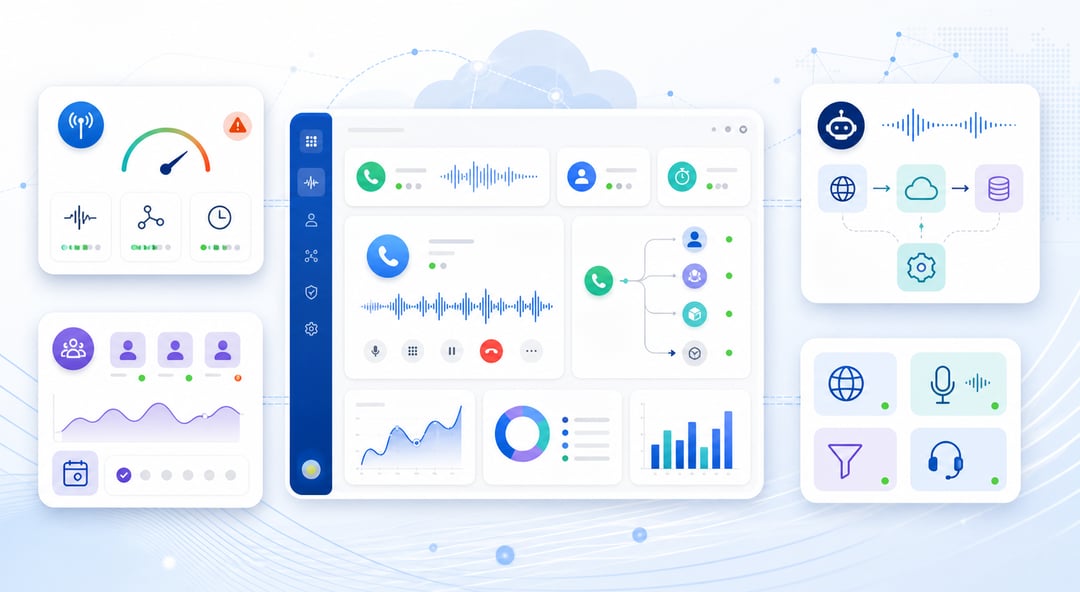
Today, a cloud PBX with native AI doesn't just route calls. It listens, transcribes, summarizes, answers, and adapts, all inside the same platform you already use to make and receive calls.
This guide breaks down exactly what that looks like in practice: the specific AI features available in a modern cloud PBX, who benefits most from each one, and how they work together to reduce costs and improve customer experience.
Article updated on September 09, 2026.
An AI Cloud PBX is a cloud-based business phone system with artificial intelligence built into its core functions, rather than added on through external integrations.
Instead of connecting your phone system to separate transcription software, a separate chatbot, and a separate analytics dashboard, the AI lives inside the platform you're already using to manage calls.
In practice, this means three things for your business:
1. No third-party dependencies. Your call data, transcripts, and AI-generated insights stay inside one system, reducing security risk and vendor management overhead.
2. No extra software to learn. Your team uses the same interface for calls, transcripts, and reports; there's no second dashboard to check.
3. Features that work together. A call answered by an AI receptionist can be transcribed automatically. A transcribed call can trigger a text-to-speech follow-up. Because everything runs on the same platform, these features connect naturally instead of requiring custom integration work.
This is the core difference between a generic "AI cloud" platform (built for training machine learning models) and an AI cloud PBX (built specifically to handle business phone conversations).
Here's what AI actually does inside a modern cloud PBX today, not as a future promise but as functionality available right now.
Traditional IVR systems ask callers to press a number for the right department. An AI receptionist listens to what the caller actually says, understands the intent, and either answers directly from your knowledge base or transfers the call to the right person, with full context attached.
Recent studies indicate that a significant share of consumers abandon calls or automated interactions when the system fails to understand what they said or requires too much repetition.
→ Full breakdown: AI Receptionist: How it works and why it beats the IVR
Every business call contains decisions, commitments, and details that disappear the moment you hang up, unless they're captured.
AI call transcription converts conversations into searchable, timestamped text in real time, then automatically generates a summary with key points and action items.
This turns phone calls from disposable conversations into searchable institutional knowledge, useful for sales handoffs, compliance audits, and training new team members.
→ Full breakdown: AI Call Transcription: Turn Calls Into Actionable Insights
Voicemails pile up, and listening to them one by one is one of the most common ways urgent messages get missed. Voicemail transcription converts every message into text automatically, delivered to your inbox or app, so your team can scan and prioritize in seconds instead of dialing in to listen.
→ Full breakdown: Voicemail transcription: how it works and why it matters
Updating a phone greeting used to mean booking a voice actor and waiting days for a studio recording. Text-to-speech generates natural, professional voice prompts directly inside your Cloud PBX, in over 40 languages, ready to deploy in minutes.
This is especially relevant for companies operating in multiple markets that need to update IVR menus, announcements, or notifications on short notice without new recording costs every time.
→ Full breakdown: Text-to-Speech Cloud PBX: Your Complete Guide
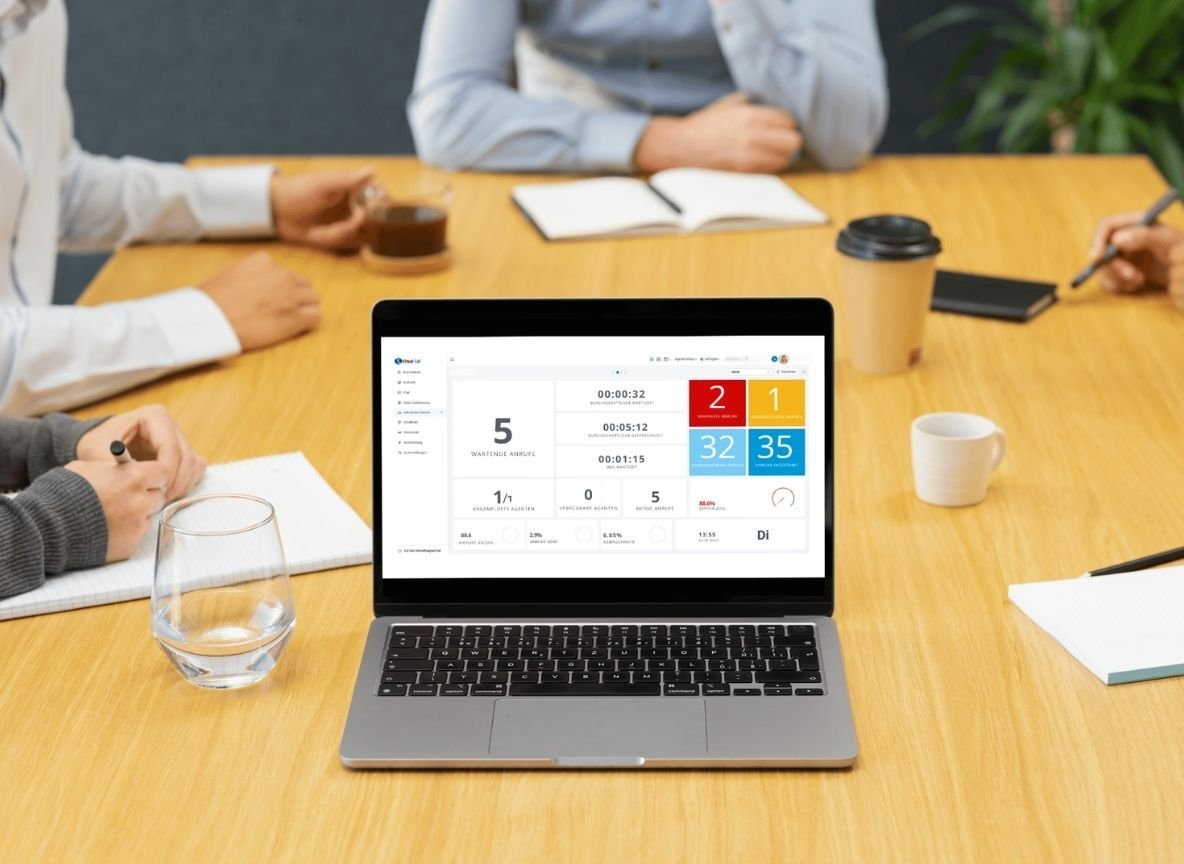
AI-powered monitoring tracks call quality metrics as conversations happen, flagging latency, jitter, or dropped audio in real time instead of relying on customer complaints to reveal a problem.
For distributed teams and multinational operations, this means IT teams can identify and resolve infrastructure issues before they affect a meaningful number of calls.
→ Full breakdown: Real-time call quality monitoring in Cloud PBX
None of these tools operate in isolation, and that's the real advantage of AI built natively into a cloud PBX rather than bolted on through third-party integrations.
A practical example: a call comes in after hours. The AI receptionist answers, understands the caller wants a product quote, and transfers the call with context to the right sales rep the next morning. That call gets transcribed and summarized automatically.
If the rep needs to send a follow-up voice notification, text-to-speech generates it in the caller's language within minutes.
Throughout the entire interaction, real-time quality monitoring ensures the audio stays clear on every leg of the call.
That's four AI features supporting a single customer interaction, without a single third-party tool or manual step.
Multinational companies use AI features to maintain consistent, on-brand call handling across countries and languages without staffing every time zone locally.
Sales teams rely on transcription and summaries to update CRMs faster and coach based on real conversations instead of assumptions.
Support teams use searchable transcripts to resolve recurring issues faster and route calls that genuinely need a human being.
Compliance and legal teams depend on timestamped, audit-ready transcripts to meet GDPR, LGPD, and industry-specific requirements.
IT managers use real-time quality monitoring to catch infrastructure issues before they turn into a wave of customer complaints.
Bringing AI into a phone system raises a fair question: what happens to the data?
With Virtual-Call, call data, transcripts, and AI-generated summaries are processed within our platform, hosted on secure, enterprise-grade cloud infrastructure.
Your conversations aren't shared with third-party AI vendors, and access is controlled by department-level policies and permissions you configure.
This matters most for companies operating under GDPR, LGPD, or industry-specific regulations, where every additional third-party vendor is another point of exposure to manage and audit.
By 2026, enterprise communication platforms will be moving beyond transcription and automated answering toward proactive intelligence: sentiment analysis that flags at-risk customers before they churn, live coaching suggestions during active calls, and predictive analytics built directly into call data.
Virtual-Call is developing in this direction, adding automated quality scoring and compliance risk alerts on top of the features already available today.
The companies that adapt fastest won't be the ones simply adopting AI; they'll be the ones who treat their phone system as a source of business intelligence, not just a utility for making calls.
If your business is still relying on a traditional IVR, manual note-taking after calls, or third-party transcription tools that don't talk to each other, there's a faster path.
Virtual-Call's Cloud PBX brings an AI receptionist, call transcription, text-to-speech, voicemail transcription, and real-time quality monitoring into a single platform, with no third-party dependencies and no extra software to manage.
Talk to our specialists and find out which AI features make the most sense for your business first.
1. What's the difference between AI Cloud and AI Cloud PBX?
“AI cloud” typically refers to broad machine learning platforms like Google AI Cloud or Microsoft Azure AI, used to build and train custom AI models.
An AI Cloud PBX applies AI specifically to business phone systems, featuring like call transcription, AI receptionists, and text-to-speech, ready to use without any model training or data science expertise required.
2. Do I need separate software to use these AI features?
No. In Virtual-Call's Cloud PBX, AI Receptionist, Call Transcription, Voicemail Transcription, Text-to-Speech, and Quality Monitoring are all native features inside the same platform you use for calls. No third-party integrations or additional subscriptions are required.
3. Which AI features are available on my plan?
AI Receptionist, Call Transcription, and Summary are available on Enterprise and Ultimate plans. Contact our team to confirm feature availability for your specific plan.
4. Is my call data secure with AI features enabled?
Yes. All call data, transcripts, and AI-generated summaries remain inside the Virtual-Call platform. No external providers access your conversations, and access is governed by the permissions and retention policies you configure.
5. Can these AI features work across multiple languages?
Yes. AI receptionists, transcription, and text-to-speech all support multiple languages, with automatic language detection for incoming calls, making them well-suited for multinational operations.
6. Will AI replace my customer service team?
No. These features are designed to handle routine, repetitive interactions, so your team can focus on conversations that genuinely require judgment, empathy, and problem-solving.
We connect you to the world! 🌏