

11 min read

A customer waits longer than usual. A call lands with the wrong agent. A supervisor only learns about a bottleneck after a customer has already complained.
These are the moments that reveal an inbound call center has outgrown its setup.
A cloud PBX built for call centers solves this: it manages every stage of an inbound call entry, distribution, queuing, live supervision, and reporting, from a single platform.
Before we get into how it works, it's worth clearing up a common mix-up: a call center handles voice calls through an ACD and IVR, while a contact center extends that logic across chat, email, and messaging too.
If your team has already read our piece on “5 Essential Tools to Optimize Your Call Center,” this article goes further into the inbound flow itself.
This article is about the voice side, the inbound flow itself, stage by stage, from ACD and skill-based routing to real-time monitoring, SLA alerts, and reporting. And for multinationals, why running all of it under one provider changes the game.
The Inbound Call Flow, Stage by Stage
Every inbound call in a cloud PBX call center passes through a defined sequence. Understanding this flow helps managers evaluate whether their current system or a prospective one actually supports the volume and complexity their team handles.
1. Entry and Triage: ACD and IVR
The moment a call reaches your business number, the Automatic Call Distribution (ACD) engine takes over.
Combined with an Interactive Voice Response (IVR) menu, this first stage identifies caller intent, department, or preferred language before the call ever reaches an agent.
A well-configured IVR reduces misrouted calls and shortens handling time downstream because agents already know why the customer is calling before they pick up.
This is the triage layer: it doesn't resolve the call, but it prepares the ground for accurate distribution.
2. Distribution: Skill-Based Routing, Availability, and Priority
Once triaged, the call needs to reach the right agent. This is where skill-based routing comes in. Rather than distributing calls purely on a “next available agent” basis, the ACD can route calls according to:
- Agent skill set: language, product knowledge, or department expertise
- Agent availability: status management (available, busy, away) ensures calls aren't sent to agents who can't take them
- Priority rules: VIP customers or urgent categories can be routed ahead of the standard queue order
Depending on the plan, Virtual-Call's cloud PBX offers enhanced skill-based routing on enterprise and ultimate tiers, giving supervisors finer control over how inbound volume is distributed across teams, a meaningful advantage for companies with segmented support lines (technical, billing, and sales) or multilingual teams.
3. Queue Management: Queue Panel, Priority Queue, and Callback
When all qualified agents are busy, the call enters a queue. This is a critical stage for customer experience, and it's also where a cloud PBX gives supervisors real operational control:
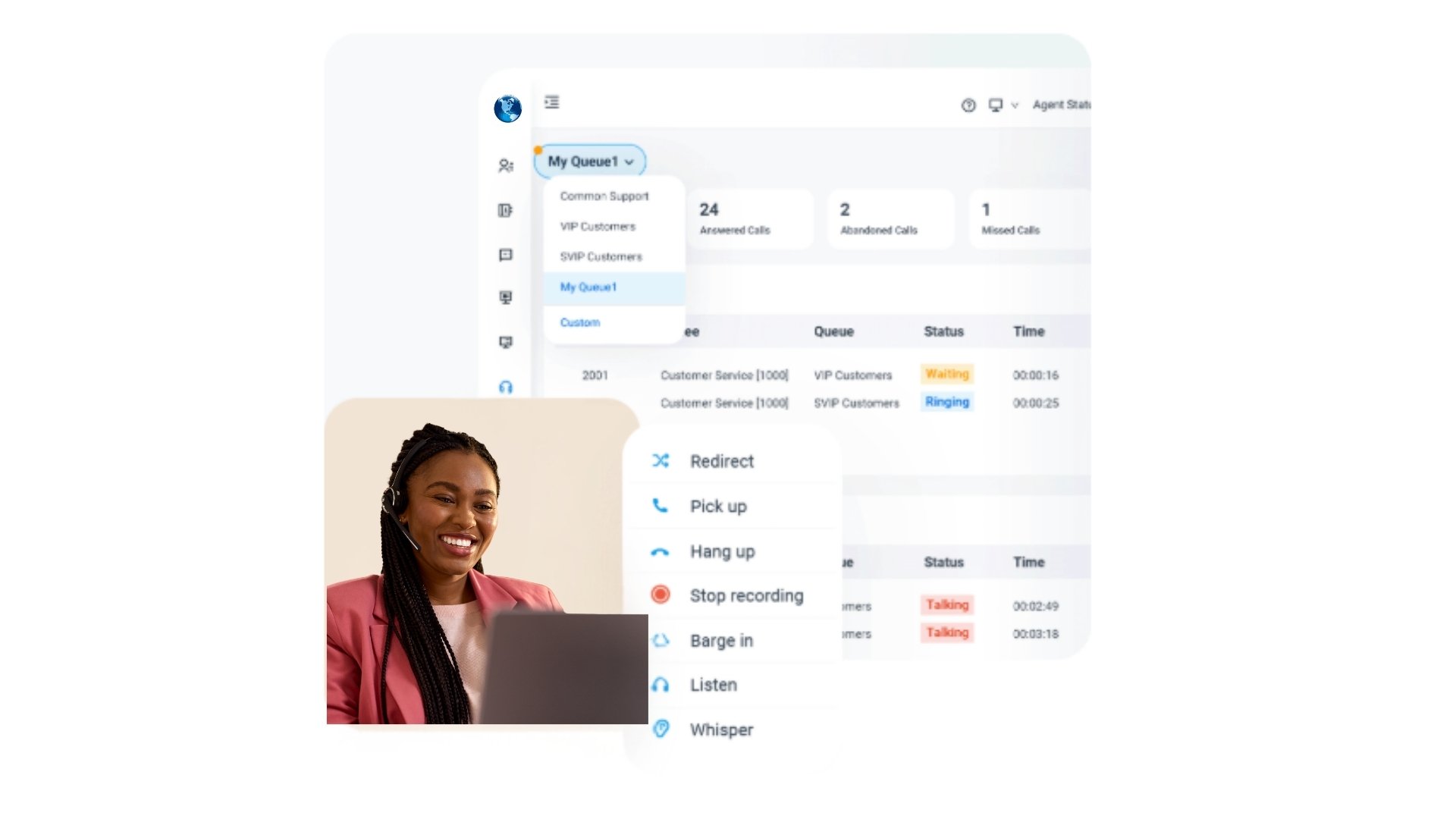
- Queue Panel: a live view of all calls waiting, with the ability to intervene, reorder, or reassign calls manually when needed
- Priority queue: ensures that high-value or time-sensitive calls are not left waiting behind routine inquiries
- Queue callback: Instead of holding the line, callers can opt to receive a callback once an agent becomes available, reducing abandonment and improving perceived wait time
These features move queue management from a passive holding pattern into something a supervisor can actively shape in real time.
4. Real-Time Supervision: Wallboard, Monitoring, Whisper, and Barge-In
While calls are being handled, supervisors need visibility into what's happening across the floor, not just after the fact.
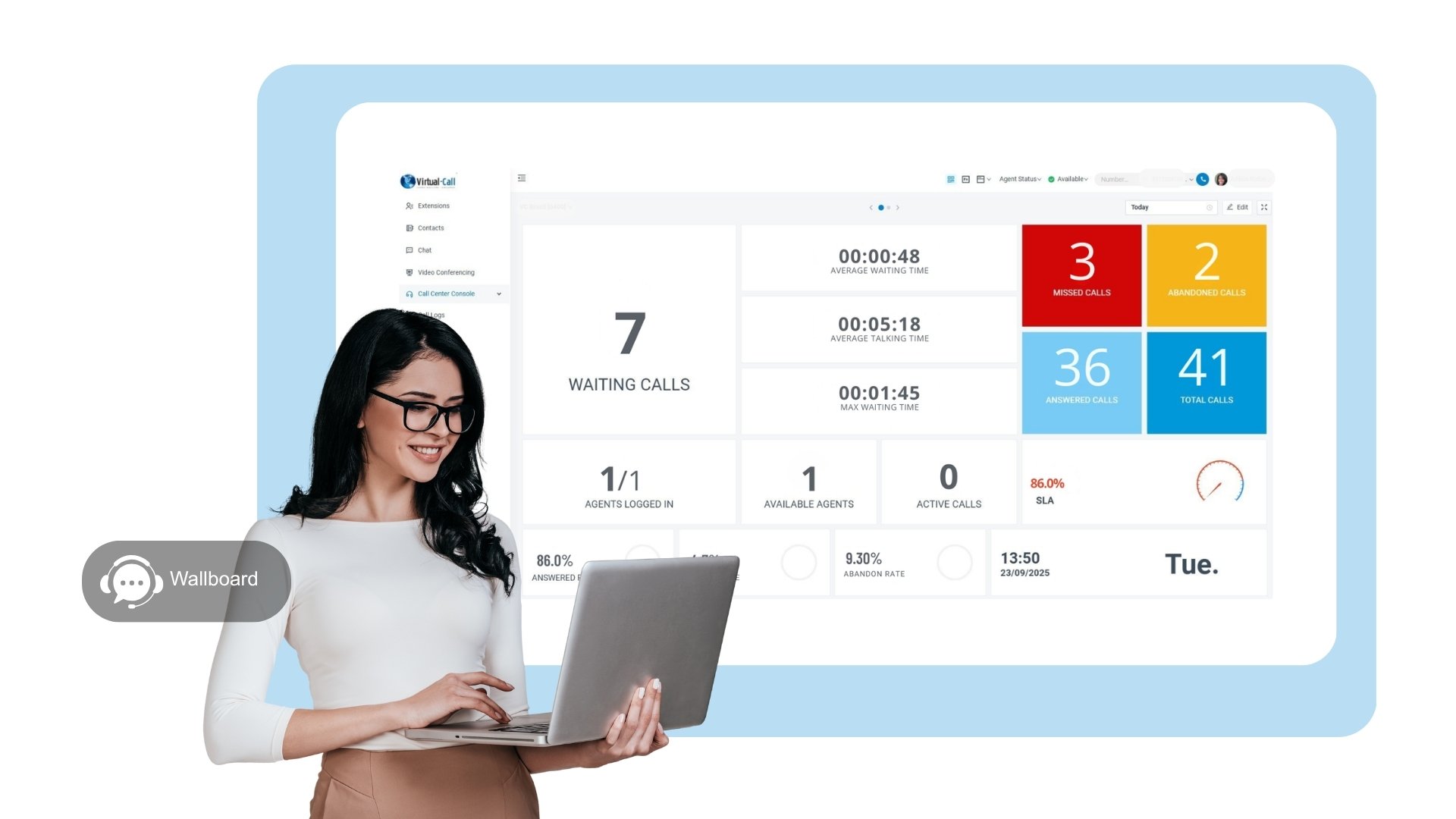
A real-time wallboard displays key performance indicators (KPIs) such as calls waiting, average wait time, and agent status, all updated live.
Beyond the wallboard, supervisors can use:
- Call monitor: listen to a live call without either party being aware
- Whisper: coach an agent during the call without the customer hearing
- Barge-in: join the call directly when a supervisor's intervention is needed
Together, these tools let team leads coach in the moment, rather than relying solely on post-call reviews.
5. Quality and SLA: Threshold Alerts
Service Level Agreements (SLAs), such as answering a defined percentage of calls within a target time, are only useful if a team knows when it's about to miss them.
SLA threshold alerts notify supervisors automatically when key metrics approach or breach agreed limits, allowing corrective action (reassigning agents, adjusting IVR routing) before the SLA is actually broken rather than after.
This proactive layer of quality control, available depending on the plan (Enterprise and Ultimate), turns SLA management from a monthly report into a live operational discipline.
6. Follow-Up: Call Disposition, CDR, and CRM Integration
After the call ends, the work isn't quite finished. Agents typically log a call disposition, a short classification of the outcome (resolved, escalated, callback requested, and so on), which feeds into later analysis.
The Call Detail Record (CDR) with a timeline gives a complete, chronological view of the call: how it was routed, how long it waited, who handled it, and how it concluded.
When integrated with a CRM, this data attaches directly to the customer record, so the next interaction, regardless of channel or agent, starts with full context rather than from zero.
7. Reporting and Analytics: Pre-Built and Custom Reports
Finally, all of this activity needs to be visible at the management level. A cloud PBX call center solution should offer both pre-built reports (queue performance, agent productivity, and call volume trends) and custom reports tailored to specific KPIs your business tracks.
Combined with queue call logs, this reporting layer is what allows leadership to move from anecdotal impressions (“It feels like wait times are longer”) to data-backed decisions.
Why Multinationals Need One Cloud PBX
For companies with a headquarters and branch offices in different countries, inbound call center performance is only half the challenge; the other half is operational complexity.
It's common for multinationals to end up with a different telephony provider in each country, which means separate contracts, separate invoices, and separate support lines to manage every time something goes wrong.
Virtual-Call addresses this directly. As a single telephony provider covering all your locations, we let multinational teams run their entire inbound operation at HQ and every branch under it:
- One contract, instead of negotiating and renewing separate agreements per country.
- One invoice, simplifying finance and cost tracking across the organization.
- One technical support team, available in English, German, and Portuguese, so every regional office gets help in a language its staff actually speaks.
This matters directly for the inbound flow described above. Skill-based routing, SLA monitoring, and reporting are only as useful as they are consistent; if each branch runs on a different system, headquarters loses the ability to compare performance, enforce the same service standards, or route overflow calls between offices.
With a single cloud PBX provider, routing logic, SLA thresholds, and reporting formats stay uniform across every country of operation, giving leadership one coherent view of inbound performance instead of a patchwork of disconnected systems.
For decision-makers managing distributed teams, this isn't a minor convenience; it's a structural simplification that reduces vendor management overhead while keeping customer service standards aligned globally.
Choosing the Right Plan for Your Inbound Volume
Not every business needs the full call center feature set from day one.
Core ACD and IVR routing provide the foundation, while advanced capabilities—such as enhanced skill-based routing, queue callback, the Queue Panel, real-time wallboards, SLA threshold alerts, and detailed call center reporting—depend on the plan and are typically available on Enterprise and Ultimate tiers.
Growing companies with rising call volumes and multinationals coordinating multiple offices are the clearest candidates for these higher tiers, since the operational visibility and control they provide compound in value as team size and call complexity increase.
Conclusion
An inbound call center is not a single feature; it's a sequence: entry and triage, distribution, queuing, live supervision, quality monitoring, follow-up, and reporting.
A cloud PBX that supports every stage of that flow, rather than just the basics, gives customer service managers the visibility and control needed to keep service levels consistent as call volume grows.
For multinational organizations, running that entire flow under one provider, one contract, one invoice, and one multilingual support team turns a complex, distributed operation into a single, manageable system.
Talk to a Virtual-Call specialist to see how our cloud PBX call center features can fit your inbound operation, whether you're running a single office or coordinating support across multiple countries.
FAQ
1. What's the difference between a call center and a contact center?
A call center handles voice interactions through an ACD and IVR. A contact center extends that same routing logic across multiple channels: voice, chat, email, and messaging under one unified queue.
2. What is skill-based routing in a cloud PBX?
It's a distribution method that sends inbound calls to agents based on their specific skills, language, or expertise rather than simply the next available agent, improving first-call resolution.
3. How does a queue callback improve customer experience?
Instead of waiting on hold, callers can request a callback once an agent is free. This reduces abandonment rates and removes the frustration of extended hold times.
4. What can supervisors see on a real-time wallboard?
A wallboard displays live KPIs such as calls waiting, average wait time, and agent status, giving supervisors immediate visibility into queue performance as it happens.
5. Are these call center features available on every Virtual-Call plan?
Core routing and IVR capabilities are included broadly, but advanced features, such as enhanced skill-based routing, queue callback, the Queue Panel, real-time wallboard, SLA monitoring, and custom reporting, are available depending on the plan, typically on Enterprise and Ultimate.
We connect you to the world! 🌍