Voicemail transcription: how it works and why it matters
Have you ever missed a client callback because voicemail messages piled up unheard? Or had to...



Managing telephony in five different countries used to mean five contracts, five suppliers, and five headaches. That scenario is changing.
Picture this scenario: your company has offices in Brazil, Mexico, the United Kingdom, South Africa, and Latvia. A customer calls your Mexico number at 3 AM local time and needs urgent support. In a traditional setup, that call would go to voicemail or wake up an on-call employee.
Now imagine a different scenario: that same call is automatically routed to your Brazil team, where it's 6 AM, and the office is just starting the workday. The customer is answered in Spanish by an agent who can see the complete interaction history on screen. No waiting. No endless transfers. No one is losing sleep.
This isn't science fiction. It's what the follow-the-sun model enables when combined with a global cloud PBX platform. And it's precisely what multinational companies are implementing to transform their customer service operations.
In this article, we'll show you how to connect operations across multiple countries with a single platform, eliminating fragmentation, reducing costs, and providing 24/7 support without overwhelming your team.
We recently received an inquiry that perfectly illustrates the scenario IT managers at global companies face. A multinational technology company headquartered in Brazil needed to structure its telephony to serve offices in five different countries:
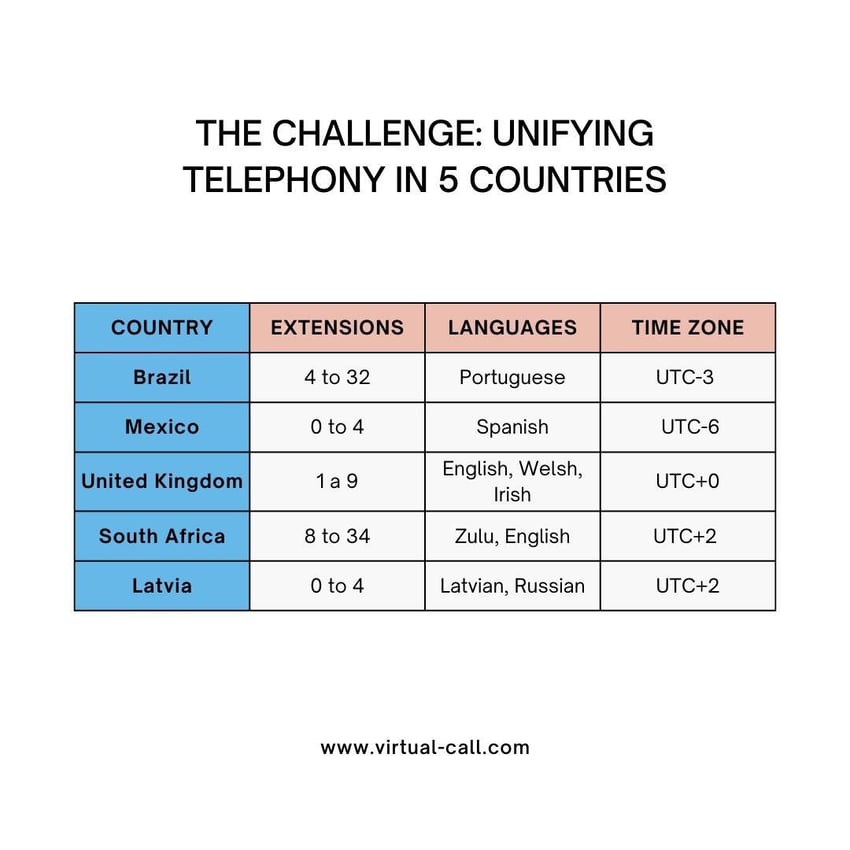
The requirements were complex: calls from any country should be answerable by any office. A Mexican customer calling outside local business hours needed to be automatically routed to Brazil. And all calls between offices should function as internal extensions, with no international call charges.
This is precisely the kind of demand that traditional phone systems simply cannot meet. And that's where the transformation begins.
The follow-the-sun model is a service and support strategy in which different teams, spread across time zones around the world, take over the work as the day progresses.
Instead of concentrating everything in a single country, forcing teams to work night shifts, paying overtime, and dealing with tired professionals, the operation “rotates” with the sun, moving from one office to another continuously.
Here's how this translates into your day-to-day operations:
Instead of each country having its own structure, rules, and limitations, follow-the-sun, combined with a global Cloud PBX platform, allows you to:
In other words, the follow-the-sun model is not just a schedule adjustment; it is a new way of designing customer service operations in which the whole world becomes a single large “virtual office” connected by the same Cloud PBX infrastructure.
By adopting the follow-the-sun model with a global cloud PBX, your company eliminates:
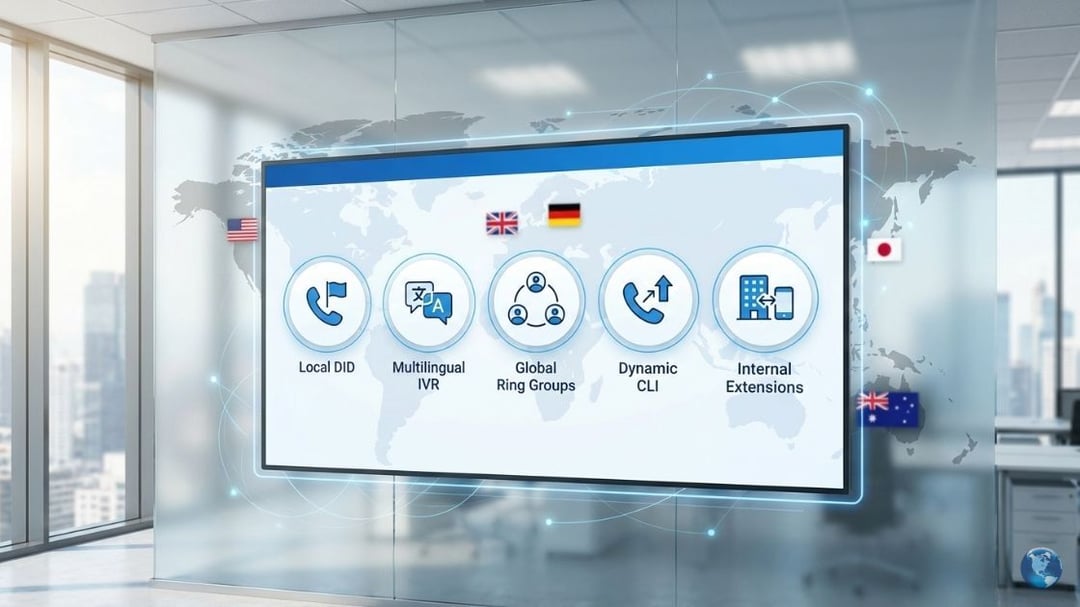
For the follow-the-sun model to work, the telephony infrastructure must be truly unified. Having separate systems in each country that “talk” to each other isn't enough; that just replicates complexity with an extra layer of integration.
The real solution is a single cloud PBX platform that treats all countries as extensions of the same virtual office.
Local DID numbers in each country
Each office maintains a local number that customers in that region recognize and trust. A customer in Mexico calls a Mexican number; a customer in Brazil calls a Brazilian number. The experience is local, but the infrastructure is global.
Intelligent multilingual IVR
The auto-attendant system offers language options at the start of the call, Portuguese, English, and Spanish, and routes the customer to the appropriate queue or agent. This eliminates unnecessary transfers and improves the experience from the very first second.
Global ring groups
A ring group can include agents from multiple countries. When a call comes in, it rings simultaneously (or sequentially) to all available agents, regardless of their physical location.
Dynamic CLI (Caller Line Identification)
When an agent in Brazil calls a customer in Mexico, the call appears on the caller ID as if it's from the local Mexican number. This increases answer rates (customers ignore unknown international numbers) and projects professionalism.
Global internal extensions
Calls between offices work as internal extensions, with no international call charges and no country code dialing. An employee in São Paulo dials “201” and speaks with a colleague in London as if they were in the same building.
Let's return to the example of the multinational technology company. Before migrating to global Cloud PBX, the situation was as follows:
5 different contracts with local carriers (one in each country).
5 invoices in different currencies to reconcile every month.
No integration between systems; each office was an island.
Technical support in different languages, with variable response times.
Sky-high costs for “internal” calls between offices (which were actually international).
After implementing global Cloud PBX:
1 single contract with consolidated billing.
1 management dashboard for all countries.
24/7 multilingual technical support (Portuguese, English, German).
Inter-office calls as internal extensions, zero cost.
Follow-the-sun support implemented in under 30 days.
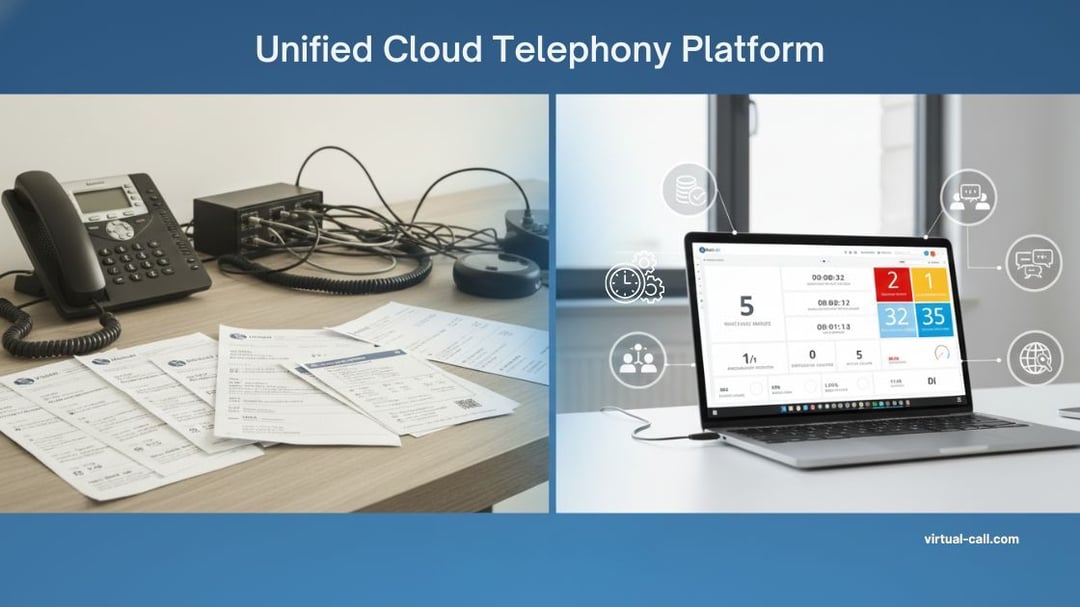
Managing telephony across multiple countries doesn't have to be a logistical nightmare. With the right Cloud PBX architecture, your company can:
Provide 24/7 support without night shifts.
Maintain a local presence in each country with regional numbers.
Eliminate international call costs between offices.
Scale quickly to new markets.
Have complete visibility of operations in a single dashboard.
Implementing follow-the-sun without proper preparation can generate frustration and waste investment.
Take our free diagnostic and discover exactly where your company stands and what needs to be adjusted.
Virtual-Call specializes in helping multinational companies unify their communications. With our infrastructure, technical support in Portuguese, English, and German, and proven experience in global implementations, we're ready to be the partner your operation needs.
Want to see how this works for your company? Fill out the form, and our team will show you how to connect your offices on a single platform.
Yes. The number portability process allows you to transfer existing numbers to the new platform. Your customers continue calling the same number; the difference is that it's now connected to a global infrastructure.
Quality cloud PBX platforms use globally distributed data centers. Calls are routed through the server closest to each end of the communication, minimizing latency. With a stable internet connection, quality is comparable or superior to traditional lines.
One of the key advantages of Cloud PBX is that it doesn't require physical infrastructure. Depending on the country's regulations, it's possible to acquire a national phone number without necessarily having a physical office.
For example, you can have a local number in Mexico operated by agents in Brazil. The local presence is virtual, but for the customer, the experience is the same.
Activating new countries can be done in 24-48 hours. Complex migrations, with number portability, CRM integrations, and team training, typically take 4 to 8 weeks, depending on scope.
We connect you to the world! 🌎