How do SMS and 2FA enhance communication and security?
In a digital era where communication and security are paramount, the role of SMS and Two-Factor...



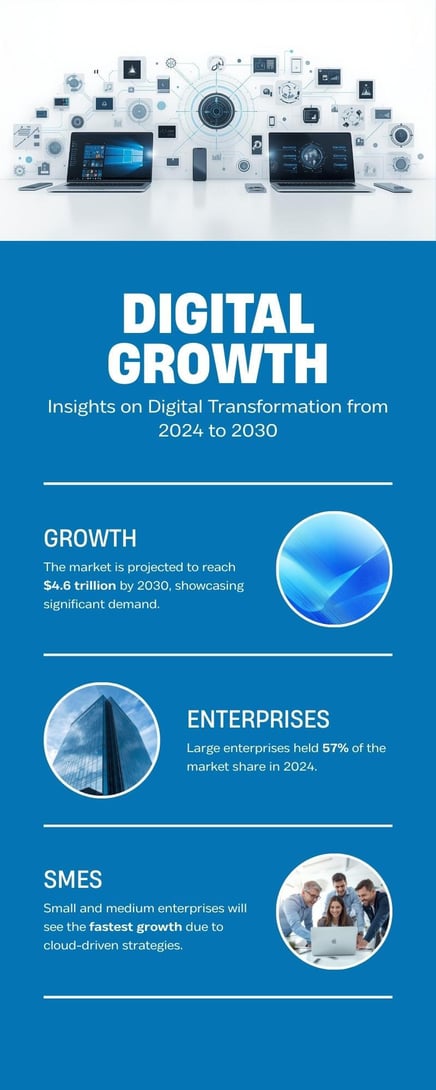
Digital transformation isn't a trend; it's a business imperative. The global market reached over $1 trillion in 2024 and is projected to exceed $4.6 trillion by 2030, more than quadrupling in just six years, according to Grand View Research.
But here's the reality: digital transformation is a double-edged sword. Large enterprises currently dominate with 57% market share, but small and medium-sized businesses are catching up fast.
Why? Cloud technology made digital tools accessible to everyone, customers demand better experiences, and businesses need to scale quickly.
Worldwide spending on digital transformation reached 1.85 trillion U.S. dollars in 2022, up over 16% on the previous year [Statista, 2024]. The COVID-19 pandemic kick-started this acceleration, with remote work prompting organizations to embrace cloud technologies that enable flexible working environments.
The companies winning this race aren't just buying new technology; they're strategically managing risks while unlocking massive gains in efficiency, innovation, and competitive advantage.
Digital transformation is reshaping the global economy at an unprecedented pace. With the market growing at 28.5% annually, organizations that embrace strategic transformation unlock extraordinary value.
The solutions segment dominated the digital transformation market with 67% revenue share in 2024. This includes analytics platforms, cloud computing infrastructure, and AI-powered automation tools that drive tangible business results.
Financial sector digitalization leads the charge, BFSI (Banking, Financial Services, Insurance) accounts for 28% of end-use revenue. Banks, insurance firms, and financial institutions are undergoing massive transformations to meet evolving customer needs through fintech solutions, blockchain technology, and AI-powered fraud detection systems.
Over 90% of organizations worldwide implemented cloud technologies as of 2023, the highest adoption rate of any emerging technology. This near-universal adoption reflects the cloud's fundamental role in enabling digital transformation.
The hosted deployment segment leads with 51.6% market share in 2024, driven by the proliferation of mobile devices and advancements in information-sharing technologies. Cloud-based solutions enable companies to adapt efficiently to evolving markets, with global public cloud spending surpassing 560 billion U.S. dollars worldwide.
Companies successfully implementing digital transformation report measurable improvements:
🔶 Operational Efficiency: Cloud technology enables businesses to scale efficiently, cut IT costs, and increase agility. Major providers like AWS, Microsoft Azure, and Google Cloud offer AI-powered analytics, cybersecurity, and automation tools that transform operations.
🔶 Market Reach: Digital transformation assists companies in improving brand reputation, customer experience, and customer retention ratios. These solutions help organizations meet evolving market needs and improve business profitability.
🔶 Data-Driven Decisions: Improved data management enables better forecasting, customer insights, and strategic planning across all business functions.
🔶 Employee Productivity: Solutions help organizations train employees to improve productivity and speed up the journey to achieve business objectives.
Artificial intelligence is revolutionizing industries through intelligent automation, predictive analytics, and real-time decision-making. AI-powered tools are used for:
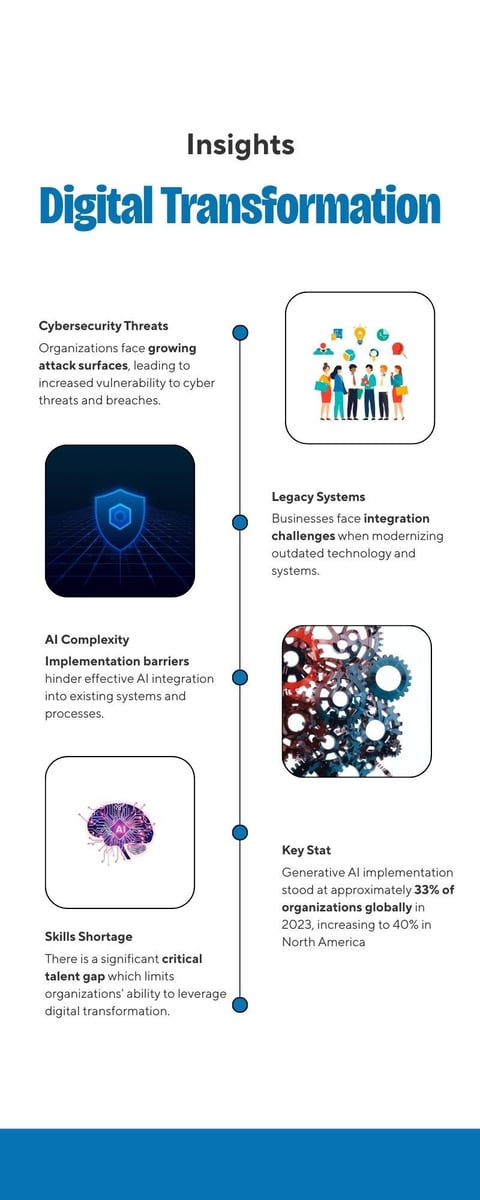
Yet generative AI adoption varies significantly. Global implementation stood at around one-third of organizations worldwide in 2023, with that share increasing to 40% in North America. AI implementation is difficult to get into because it's so complicated. This makes it hard for smaller businesses with limited budgets.
Integrating AI and cloud computing fuels digital transformation, transforming healthcare, finance, manufacturing, and retail industries.
Understanding the barriers organizations face is as important as understanding opportunities. Digital transformation is a major challenge that requires strategic planning to be successful.
Companies must effectively use enormous amounts of data and transform their processes digitally. Management needs to rethink approaches, and employees need targeted training to keep pace with new technologies.
Customer communication is increasingly shifting to online formats, placing new demands on marketing. Security of digital infrastructure must be guaranteed, as cyberattacks are becoming increasingly common.
Despite AI's transformative potential, the majority of organizations worldwide are yet to implement generative AI technology. When implemented, AI and machine learning enable:
However, complexities associated with AI implementation set a high bar for entry, posing challenges for smaller organizations with restricted budgets.
Beyond obvious challenges, several hidden risks derail transformation efforts:
🔸Legacy System Integration: Organizations running older technology face massive integration challenges when implementing modern cloud platforms.
🔸Skills Gap: The widespread adoption of new digital processes has spurred a reassessment of workforce roles. Certain technologies require specialized skills and competencies. Machine learning, data analytics, and cybersecurity skills are seeing increased demand.
🔸Geographic Skill Disparities: Companies must address the global talent shortage strategically. Many organizations look to regions like India, which tops rankings of AI skills penetration, while others invest in upskilling current employees amid the surging market for corporate e-learning.
🔸Change Management: Digital transformation affects the entire company and requires strategic planning to succeed. It's not just about technology; it's about people, processes, and culture working together.
SMEs are embracing digital transformation at a 28.3% annual growth rate, driven by superior customer experience needs and scalability demands.
What separates successful transformations from failures? Research from Grand View Research and Statista identifies clear patterns:
North America dominated the digital transformation market with over 43% revenue share in 2024, driven by:
Large organizations dominate with 57% market share in 2024. However, the small & medium-sized enterprises (SMEs) segment is expected to grow at the fastest rate.
What's driving SME acceleration?
The market is consolidated, with key players engaging in mergers, acquisitions, partnerships, and product launches to expand their footprint. Examples include:
These strategies enable companies to innovate, enhance end-user experience, and stay competitive.
Organizations that build data literacy across teams see better results. The task is to strike a balance as companies forge ahead with powerful new technologies while factoring in pressing cybersecurity and ethical concerns.
Employees must enhance their skills portfolio to succeed in a global job market that demands digital fluency and a willingness to embrace change.
Based on market research from Grand View Research and Statista, here are proven implementation strategies:
Don't lead with technology; lead with problems. The rapid digitalization of sectors like financial services drives demand for digital transformation solutions. Banks and financial institutions seek:
Cloud computing adoption is boosting market growth by enabling businesses to scale efficiently, cut IT costs, and increase agility. Cloud service providers offer:
With over 90% of organizations implementing cloud technologies, this is no longer optional; it's foundational.
AI is revolutionizing industries, but implementation requires careful planning:
Start small: Focus on high-impact use cases like:
Prove value: AI-powered tools improve efficiency, reduce costs, and enhance innovation.
Scale systematically: Expand after demonstrating ROI in initial implementations.

Anticipated to expand at a substantial 28.3% CAGR, SMEs are embracing digital transformation, driven by the need for superior customer experience and scalability.
Growing concerns over cybersecurity and regulatory compliance drive organizations to integrate:
Organizations are integrating secure payment solutions, AI-based authentication, and cloud-based financial management systems to enhance transparency and efficiency. Customer-centric transformation drives competitive advantage.
Digital transformation manifests differently across sectors. Here's what leading research reveals:
BFSI led the market with 28% revenue share in 2024. Key drivers:
Transformation priorities:
Manufacturing sectors embrace specialized robotics and automation. Digital transformation enables:
North America digital transformation in the manufacturing market is expected to reach $53.70 billion by 2030.
Digital transformation is anticipated to improve the quality of patient care. The healthcare segment is expected to grow with significant momentum during the forecast period.
The digital transformation market in Europe is anticipated to grow at a notable rate from 2025 to 2030. Growth factors include:
For telecommunications providers and enterprises, cloud-based solutions represent essential infrastructure for digital-first operations. Solutions like Virtual-Call's Cloud PBX, SIP Trunking, and MS Teams Direct Routing enable:
Digital transformation in 2025 is no longer optional; it's existential. With the global market projected to reach $4.6 trillion by 2030 and over 90% of organizations implementing cloud technologies, the question isn't whether to transform, but how to do it successfully.
The data is clear: 57% market share remains with large enterprises, but SMEs are growing at the fastest rate, driven by accessible cloud technology and customer experience demands. The difference between success and failure comes down to:
🔸Strategic alignment between technology and business goals.
🔸Cloud-first infrastructure as the foundation.
🔸AI implementation focused on specific, high-impact use cases.
🔸Security-first mindset addressing cybersecurity concerns.
🔸Customer-centric transformation driving retention and brand reputation.
🔸Continuous skills development to address the talent gap.
The risks are real: AI implementation complexity, cybersecurity threats, and skills shortages. But the opportunities are extraordinary: quadrupling market size in six years, operational efficiency gains, new revenue streams, and competitive advantages that compound over time.
North America leads with 43% revenue share, but growth opportunities exist globally. Europe is accelerating, Asia-Pacific shows strong AI skills penetration, and markets worldwide are investing in digital infrastructure.
Companies that navigate digital transformation strategically won't just survive the next decade; they'll define it.
The digital landscape evolves daily. Subscribe to our blog for:
Subscribe to the Virtual-Call Blog and join a global community reshaping business through strategic digital transformation.
We connect you to the world!🌏
Reference:
Grand View Research (2025). Digital Transformation Market Size.
Statista (2024). Digital transformation - statistics & facts.