UCaaS Implementation: Security in Unified Communications
As digital transformation becomes a widespread trend in business, the rapid evolution of...


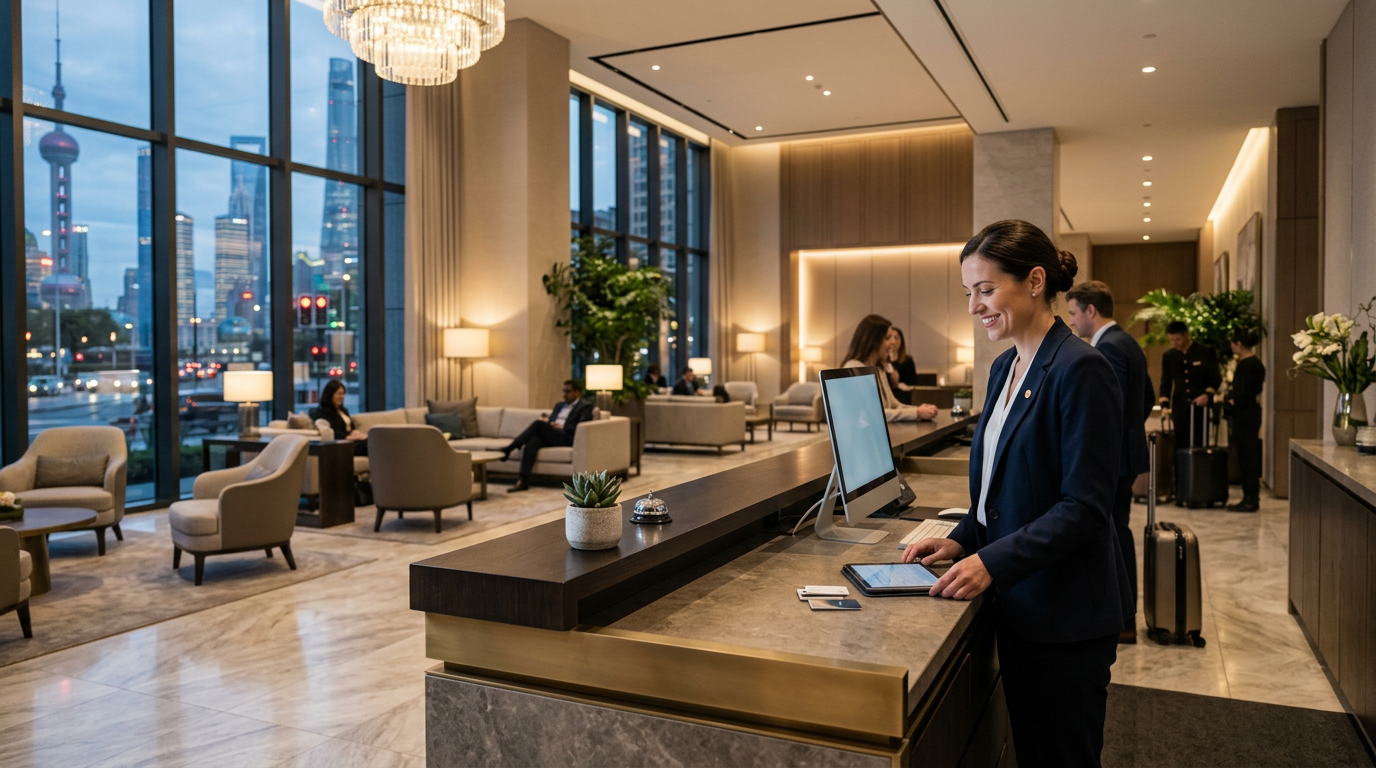
Virtual-Call's Cloud PBX includes a native hotel management module that centralizes check-in, check-out, housekeeping, wake-up calls, and guest billing in a single platform, with no additional PMS, no third-party integrations, and no separate support contracts required.
Managing telephony across multiple hotel properties, each with its own contracts, vendors, and support teams, creates a level of operational complexity that grows with every new location.
For international hotel groups, that complexity has a direct cost: slower check-ins, inconsistent guest experiences, and IT teams stretched across too many systems.
Virtual-Call's Cloud PBX eliminates that complexity. The platform includes a native hotel management module covering room operations, wake-up calls, housekeeping, and guest billing, built directly into the telephony system.
No separate PMS is required. No third-party integrations to maintain. One platform, one provider, one support contract, across every property, in every country.
This article covers every feature in the module, who it's designed for, and what changes in daily hotel operations when everything runs in one place.
The hotel management module is a set of hospitality-specific operational features embedded natively within the Cloud PBX platform, not bolted on through a third-party integration.
Front desk staff access room management, guest billing, wake-up call scheduling, and housekeeping status from the same desktop or web-based interface they use to manage calls. There is no context-switching between systems, no duplicate data entry, and no dependency on external software availability.
For hotel groups operating across borders, this means a single platform can be deployed, configured, and managed centrally, with consistent workflows and permissions across all properties, regardless of location.
Already running a PMS? The Cloud PBX supports custom integration via open API, allowing your existing property management system to communicate directly with the telephony platform, without replacing what already works.
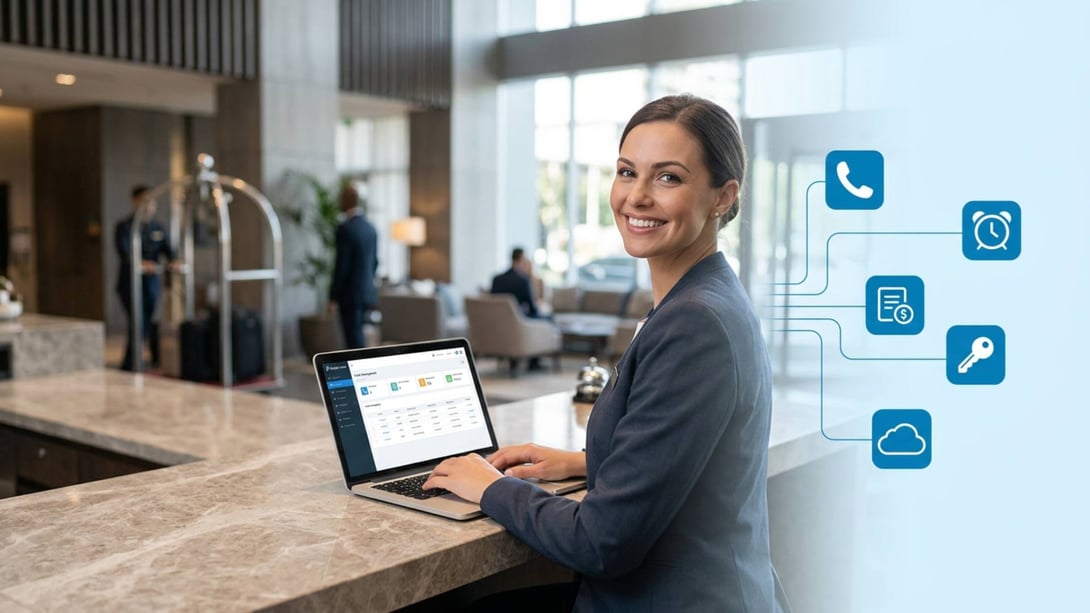
The module is purpose-built for:
Boutique hotels, B&Bs, and independent properties (typically 10 to 200 rooms) that want a single operational platform without the cost and complexity of an enterprise PMS.
Mid-size hotels looking to replace fragmented legacy systems, including separate PBX hardware, manual housekeeping logs, and untracked guest call billing.
International hotel groups that need centralized management across multiple properties and regions, with a single provider, a single contract, and support available in English, German, and Portuguese.
Most hotels, and virtually all multi-property groups, reach a point where operational complexity outpaces the tools managing it:
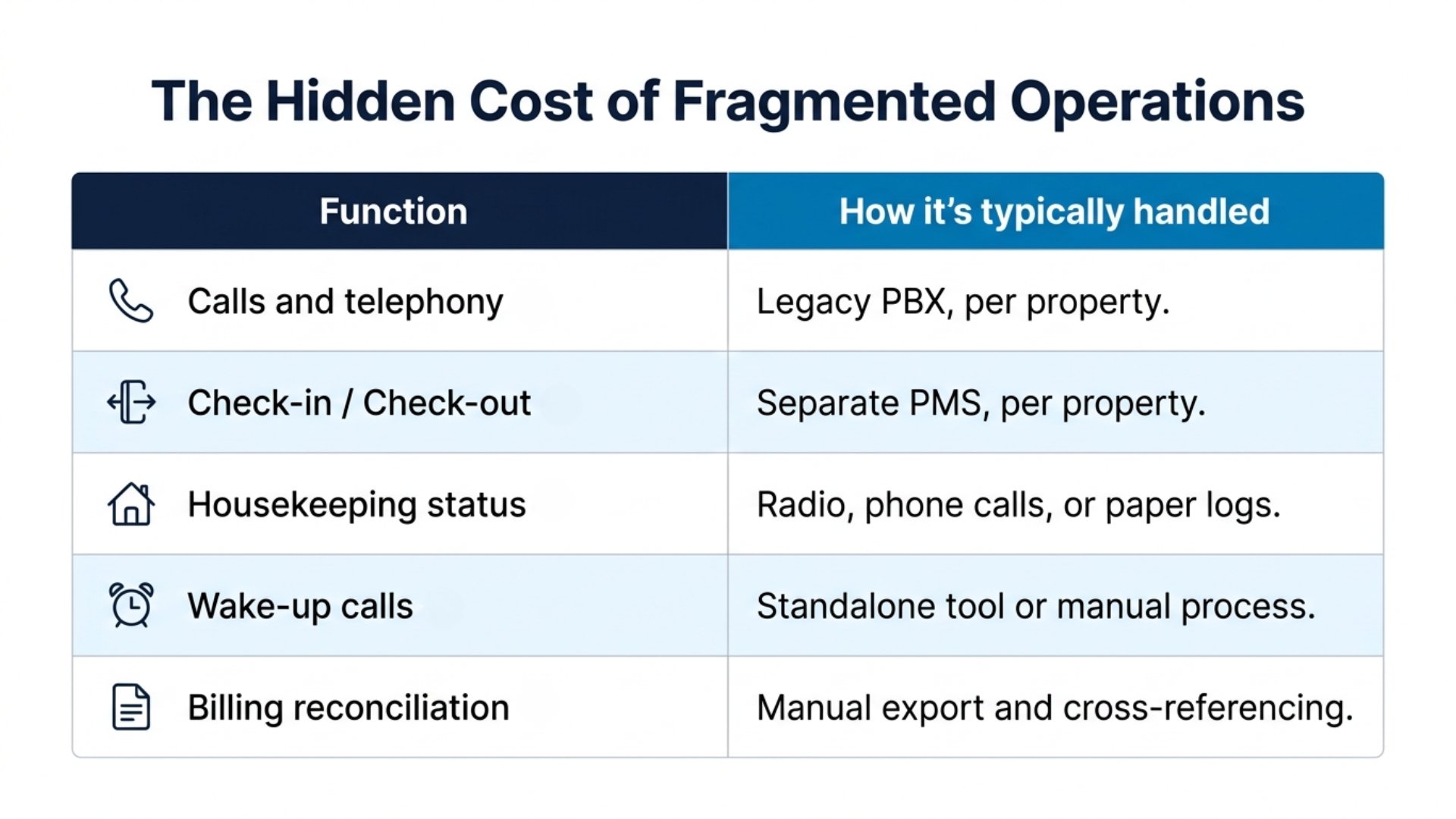
Each system comes with its own vendor, contract, and support escalation path.
For a group running five properties in three different countries, this can quickly add up to fifteen or more active vendor relationships—each carrying a separate renewal schedule, its own failure points, and a distinct invoice to track.
Hotel groups that have migrated from fragmented legacy systems to a unified cloud telephony platform consistently report the same outcomes: significantly reduced IT workload, elimination of check-in and check-out sync failures, faster room turnover, and improved guest satisfaction.
What previously required manual coordination across multiple tools becomes automatic and real-time.
For multi-property operators, the impact is even greater: centralized management replaces the need to maintain independent systems and IT support structures at each location.
Virtual-Call consolidates this into a single cloud platform, managed remotely from one dashboard, supported by one team, and available in English, German, and Portuguese.
The room panel is the front desk's command center. It displays real-time status for every room in the property and enables all core guest operations from one screen.
Key capabilities:
Check guests in and out with a single click
Filter vacant rooms instantly by room type or status
Move a guest between rooms with automatic transfer of all data, settings, and billing history
Define up to 10 custom room types and 20 room status labels (e.g., “Needs Inspection,” “VIP Setup Complete”)
Set wake-up calls and review billing details without leaving the panel
Staff no longer need to navigate multiple tools to handle a single guest request.
Corporate groups, tour parties, and event attendees don't have to mean a bottleneck at reception. The module supports bulk check-in for up to 64 guests simultaneously.
Group operations include:
Simultaneous room assignments and wake-up call scheduling for the entire group.
Centralized group billing.
Collective call permission settings.
Automatic creation of a temporary extension group at check-in, automatically dissolved at check-out.
Wake-up call failures have direct consequences for guest satisfaction. The module is built to prevent them.
How it works:
Schedule by recurrence: one-time, daily, weekly, or monthly.
Color-coded task view: scheduled, completed, or failed.
Automatic retry on unanswered calls, with configurable retry count and interval.
Configurable fallback destination for persistent non-answers.
Guest self-service: guests can set, query, and cancel their own wake-up calls directly from the room phone, with no front desk contact required.
Full execution logs are available for audit and review.
The module connects housekeeping directly to the front desk, with no calls, messages, or manual updates required.
How status management works:
Housekeeping staff update room status by dialing a feature code from the room phone.
The Room Panel reflects the change instantly.
Status can be updated individually or in bulk.
Built-in statuses: Dirty, Clean, Inspected, Under Repair, Available, Unavailable, plus up to 20 custom statuses.
Room status automatically resets to default at check-in, check-out, or on a configurable schedule.
Result: fewer internal calls, faster room turnover, and a front desk that always has accurate occupancy data.
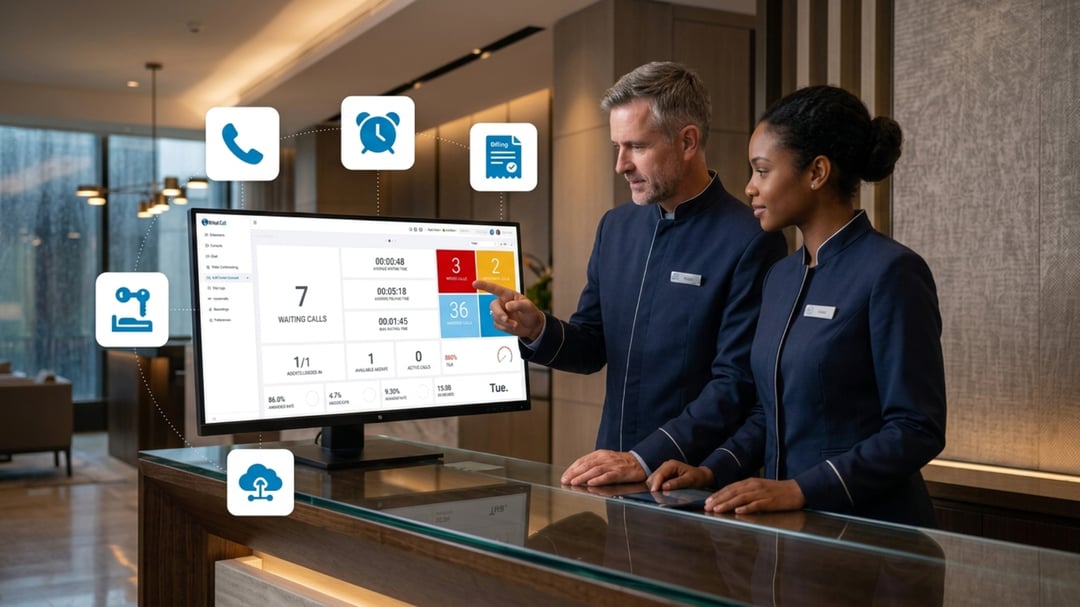
Returning guests expect recognition. The module stores complete stay records for every guest, including check-in and check-out timestamps, room assignments, room changes, and billing history.
What staff can do with this data:
Retrieve a guest's full history in seconds
Filter records by date range, room type, or stay duration
Use historical data to support loyalty programs or targeted outreach
Download filtered records as CSV for external analysis
Storage capacity: up to 100,000 stay records
Call charges are automatically calculated and logged against the guest's account in real time. No manual tracking, no end-of-stay reconciliation.
Billing capabilities:
Configurable call rate rules by dialing prefix, call duration, initial cost, and per-unit rate.
Manual charge entry for additional services: minibar, laundry, room service, and others.
Multi-currency support is essential for international properties receiving guests from multiple countries.
Check-out invoice generated as a branded PDF with hotel logo, name, address, and contact included.
Live billing view is available at any point during a guest's stay.
Guests check out with a clear, itemized invoice. No disputes, no recalculations at the desk.
Want to understand how the Cloud PBX fits into your hotel's operations? Talk to our team with no commitment required.
The module allows front desk staff to set call permissions per guest at check-in as a core part of the operational workflow, not an afterthought.
Permission levels:
Blocked (default): room phone limited to internal hotel services and emergency numbers
Domestic: outbound calls within the country permitted
International: outbound international calls permitted
Permissions are tied to the guest, not the room. At check-out, all settings reset automatically, with no residual permissions, no unauthorized usage, and no billing disputes.
The hotel management module runs on Virtual-Call's cloud telephony infrastructure, engineered for reliability and operational continuity.
Cloud redundancy ensures uninterrupted operation
Scales to properties of any size, from a 15-room boutique to a 500-room hotel
Centralized remote management across multiple properties from a single dashboard, with no on-site hardware to maintain or replace
Consistent deployment across geographies, with no dependency on local infrastructure.
Consider a typical front desk workflow without an integrated system:
The guest arrives, and check-in is logged in the PMS.
Room phone permissions are set manually in the PBX, if remembered.
Housekeeping updates are communicated by radio or phone call and manually entered in a separate log.
A wake-up call is requested and entered in a scheduling tool or written on paper.
At check-out, call charges are pulled from the PBX and manually added to the PMS invoice.
Each step is a handoff. Each handoff is a potential failure.
With the hotel management module, all five steps happen in one interface, with automatic data transfer, automatic resets at check-out, and a complete audit trail.
For groups managing this across five, ten, or twenty properties, the operational impact compounds accordingly.
For international hotel groups, the challenge isn't just choosing the right platform. It's finding a provider capable of delivering consistent service across borders.
Virtual-Call is a Swiss cloud telephony provider with operations across Europe, the Americas, and the APAC region.
The Cloud PBX is a fully managed, cloud-native platform with no on-site hardware dependencies, deployable across multiple properties from a single account, with centralized billing and remote management.
What that means in practice:
One contract covering telephony and hotel operations across all properties.
One support team, available in English, German, and Portuguese.
Transparent pricing with no hidden modules and no surprise licensing tiers.
Swiss-standard reliability, ISO 27001 certified, GDPR/DSGVO compliant, hosted in geo-redundant European data centers.
Scalable by design: add properties, rooms, or users without changing providers.
The hotel management module is included natively, not as a paid add-on and not as a third-party integration.
Hotels that already operate an established property management system don't need to replace it.
Virtual-Call's Cloud PBX exposes an open API that enables custom integration between your current PMS and the telephony platform, keeping your existing workflow intact while adding full telephony management.
Running hotel communications across multiple properties, vendors, and countries creates operational drag that compounds over time.
Virtual-Call's Cloud PBX consolidates telephony and hotel management into a single platform: one provider, one contract, one support team, with the reliability, scalability, and multilingual support that international hotel groups require.
If you want to see how the platform performs across your properties, our team is ready to walk you through the full module and build a proposal matched to your operational structure.
Suggested reading:
🔸If you manage multiple hotel properties across countries, this article shows how global teams standardize cloud telephony with one provider: Follow the Sun: One Cloud PBX for Global Operations
🔸If you want a quick baseline before evaluating hotel-specific features, here are the core capabilities every cloud PBX should cover: 7 cloud PBX features every business phone system must have
A PMS (Property Management System) focuses on reservations, distribution, and commercial operations.
Virtual-Call's Cloud PBX includes a hotel management module focused on daily front desk operations: check-in, check-out, wake-up calls, housekeeping, call control, and billing. For small and mid-sized hotels, it replaces the PMS. For hotels with an existing PMS, it integrates via open API.
No. The hotel management module comes built into the platform at no additional cost and with no separate licensing. Boutique hotels, B&Bs, and mid-sized properties can run the entire front desk operation from the Cloud PBX, with no separate PMS contract required.
Virtual-Call's Cloud PBX integrates natively with PMS platforms that support the FIAS protocol, including Oracle Hospitality Opera, Micros Fidelio, and others.
For systems that do not use FIAS, integration is delivered through a custom open API, keeping your existing PMS in place without forcing a replacement.
FIAS-based integration is included with the platform. Custom integrations through the open API are scoped per project, depending on the PMS involved.
There are no hidden module fees and no surprise licensing tiers—every feature of the hotel management module is native to the Cloud PBX.
Yes. Guests can schedule, query, and cancel wake-up calls directly from the room phone, without contacting the front desk. The system also provides automatic retry on missed calls, with configurable retry count and interval, plus a fallback destination for persistent non-answers.
At check-in, the front desk sets the call permission level for each guest: blocked (internal services only), domestic, or international. Permissions are tied to the guest, not the room. At check-out, all settings reset to default automatically, eliminating residual permissions and unauthorized charges.
Yes. The platform meets GDPR requirements and Swiss data protection standards (FADP).
Data is stored in geo-redundant European data centers, with ISO 27001 certification, role-based access control, and encryption in transit and at rest. Hotel groups operating across multiple jurisdictions can rely on a single compliant infrastructure.
The platform runs in the cloud with built-in redundancy and high availability. A secondary internet connection (failover) is recommended to ensure continuity in case of local outages. Once connectivity is restored, all room statuses, calls, and operational data sync automatically, with no data loss.
We connect you to the world! 🌏