AI Receptionist: How it works and why it beats the IVR
In 2024, research indicated that 38% of consumers abandoned calls when the automated system failed...



With this new version, Virtual-Call Cloud PBX moves from beta to general availability, introducing real-time call quality monitoring per extension and an AI receptionist equipped with its own HTTP-based tools.
If your IT team has ever spent hours tracing the root cause of a bad call without knowing whether it was the network, the carrier, or the extension. This update changes that equation directly.
Tracking down the cause of poor call quality used to be time-consuming, and it typically happened after the fact, once a customer had already complained.
The new call quality monitoring feature changes that:
For individual extensions, you can now monitor call quality while a call is still in progress, not only afterward.
The system automatically generates a per-call report as well as a summary report at the extension level, with metrics such as MOS score, packet loss rate, jitter, and latency.
If a monitored call is rated as having poor overall quality, the system automatically triggers a notification—administrators find out about problems before customers or employees have to raise them.
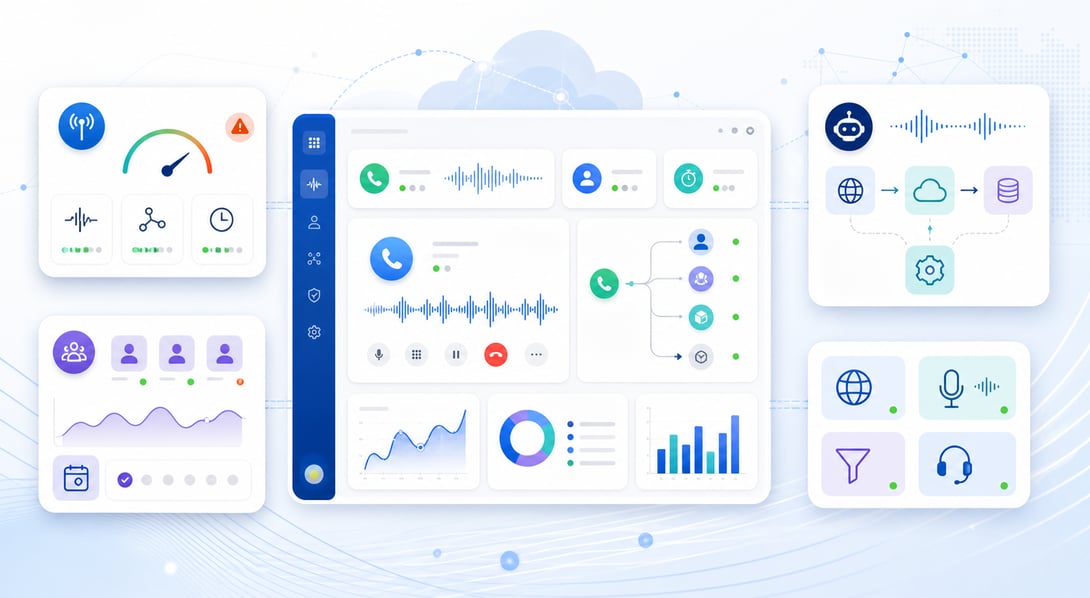
The new Quality of Service Report can be filtered by extension, organization, client type, or network type and saved as a recurring scheduled report, a practical fit for multi-site operations or contact centers that need segmented visibility without manual exports.
The per-call report is also available directly in the Virtual-Call UC Client, whether on desktop, web, or mobile.
The second headline feature is the evolution of the AI receptionist, which can now be equipped with custom tools based on HTTP requests.
In practice, during a live call, the AI receptionist can:
Every tool call is fully logged: name, execution status, and the data exchanged, creating transparency and making troubleshooting straightforward if an integration doesn't behave as expected.
This reflects a core Virtual-Call principle: AI as a concrete, auditable capability, not a marketing claim.
Alongside the two headline features, this release includes V24.3-GA:
Important: If you use the Bandwidth SMS integration, update its authentication to OAuth 2.0 by December 2, 2026, to avoid a service interruption.
1. What is real-time call quality monitoring?
It's the ability to track technical call metrics, MOS score, jitter, and latency packet loss while a call is still active, so issues can be identified and resolved before they affect the customer experience.
2. Does the AI receptionist replace a human agent?
No. It automates specific, well-defined tasks (external lookups and actions), freeing your team to focus on interactions that require judgment and empathy.
3. Do I need to configure anything to use these features?
Call quality monitoring is enabled per extension from the admin portal. AI receptionist tools need to be manually configured to connect to the external systems you want to use.
V24.3-GA delivers two concrete advances for Virtual-Call Cloud PBX customers: real-time visibility into call quality and an AI receptionist that can act, not just respond.
Together, they shorten diagnosis time and expand automation without sacrificing transparency—the same principles that define how Virtual-Call operates. These capabilities are already available in Cloud PBX.
Want to see how these features fit your operation? Talk to a Virtual-Call sales consultant and find out how Cloud PBX can reduce response time and improve customer experience for your team.
We connect you to the world! 🌏